
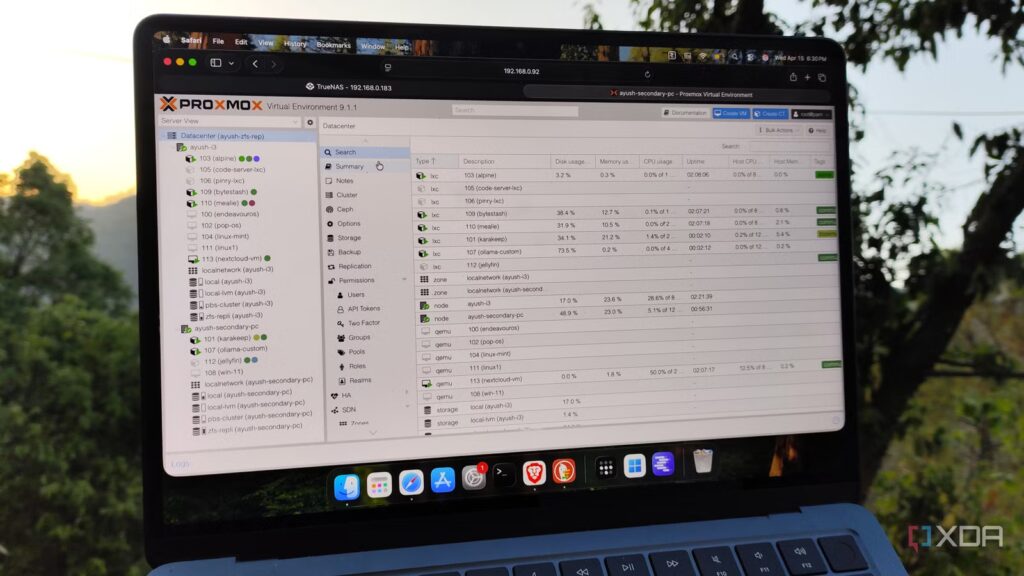
Over the past two years, I’ve installed Proxmox on PCs of all shapes and sizes, including enterprise servers, dinosaur machines, single-board computers, and gaming laptops. After all, the lightweight nature of Proxmox allows me to run this awesome platform on anything with an x86 processor, and since it supports Linux containers and KVM-based virtual machines, I can use my PVE-powered systems as workstations for creating hybrid projects and self-hosting hubs.
But no matter which version I’m using, Proxmox’s default settings are far from ideal – so much so that I often change them as soon as I’ve finished installing the virtualization platform on a new guinea pig device.
5 Common Proxmox Mistakes Everyone Makes When Starting From Scratch (And How to Avoid Them)
Yeah, I made some of these mistakes early on in Proxmox
By default, Proxmox uses its corporate repository for updates
It’s impossible to get updates without enabling the no-subscription repository

While most PVE enthusiasts are familiar with the enterprise repository, I’ve often seen newcomers leave their Proxmox update settings at default and wonder why the platform isn’t receiving new packages or security patches. You see, Proxmox sets its enterprise repository for updates during a fresh install, and unless you have purchased a subscription, your Proxmox node will throw errors if you try to update it.
Fortunately, Proxmox has a subscription-free repository, which includes almost all the tools you need to turn your PVE node into a powerful server. I used to enable it manually by going to the Updates section of the Data Center tab back then, although I started running the post-installation script from the community-driven Proxmox VE-Helper Scripts package. In addition to fixing the update repository issue, it also removes the subscription issue and disables some services from the cluster – once I give it approval, of course. And unless I intend to use a node in a cluster, I almost always leave them disabled…
Disabling certain cluster settings reduces pressure on the SSD
I also enable Log2Ram on old SSDs
Let’s be clear: as much as I like hard drives, I configure Proxmox installs on SSDs, partly because my bulky hard drives can’t fit in half the mini-PCs in my arsenal, and also because I have spare SSDs recycled from outdated machines. But reliability is a bit of an issue with recovered drives, especially for SSDs with limited write cycles. Worse still, pve-ha-lrm.service and pve-ha-crm.service tend to frequently write data to the Proxmox boot device. Now I check the disk health of my SSDs before sending them through the PVE shredder and I only use cheap disks for test systems, not for my main workstation.
Disabling these cluster services not only prevents additional SSD wear on my standalone nodes, but also slightly decreases the resources they would otherwise siphon off when writing to my boot drives. Since I’m worried, I also configured Log2Ram on cheaper Proxmox systems that I cobbled together from old components. True to its name, this handy tool writes most logs to system memory and only saves them to the SSD at infrequent intervals, further reducing write operations.
I always configure a Pulse agent on new PVE nodes
Pulse is by far the best home lab monitoring utility
Proxmox undoubtedly has a neat web UI for managing containers and virtual machines, but it’s not the best for quickly checking the health and resource consumption metrics of my virtual guests. Luckily, genius developer rcourtman has built Pulse, a powerful monitoring service that works extremely well with Proxmox. In addition to automatically discovering my LXCs and VMs, it can extract all their essential statistics and even supports remote monitoring of multiple PVE nodes.
And that’s where the aforementioned Agent Pulse comes into the picture. I have a centralized Pulse instance on a secondary node that I’ve armed with all the documentation and networking tools (so as not to destroy it with my home lab experiments), and the agents section in Pulse settings generates a new command that I can run on new PVE instances to add them to my monitoring server.

It is undoubtedly the best monitoring utility for Proxmox
Pulse is a solid addition to any Proxmox enthusiast’s container suite
Proxmox default power settings are not optimized
I often fiddle with BIOS settings on power-hungry systems

I have mostly old equipment powering my home lab, so one would expect the power consumption rate to be off the charts. But with the right set of optimizations, it’s possible to alleviate a bit of the power-hungry tendencies of Proxmox platforms. I adjust the scaling throttle on each new PVE node, as this setting is responsible for adjusting CPU clock speeds during different tasks, including idle workloads. Specifically, I set the scaling throttle to PowerSave instead of the default performance profile, which aggressively reduces CPU frequency when not actively in use.
Since my Proxmox machines aren’t involved in high-CPU-intensive tasks (at least, unless I’m specifically using them to host remote gaming VMs) and tend to sit idle most of the time, Power Save is the perfect option for my setup. I also enabled C states, Eco mode, and ASPM (and disabled boost clocks) in the BIOS of most PVE nodes, just to save a few extra watts each month.
Some additional tweaks for Proxmox enthusiasts

Proxmox’s solid companion tools are another reason I love its ecosystem, and I’m always pairing new PVE nodes with its Datacenter Manager utility. In addition to providing a neat user interface including all the systems in my home lab, it allows me to migrate LXCs and VMs seamlessly between nodes, even if they are not grouped. I also connected multiple PVE platforms to my local Proxmox Backup Server instances, although I began restricting my snapshot automations after nearly choking a PBS-powered mini-PC with unnecessary virtual guest files.
In the meantime, if you’re looking for tips to improve your VM’s performance, I recommend setting the CPU option to host. Although you should not use it on cluster nodes carrying different CPU types, the host setting can improve the responsiveness of your VM. Likewise, changing the display option to SPICE eliminates cursor lag and general sluggishness on GUI-heavy VMs, and I wish I had known about this setting when I first started using Proxmox.
