
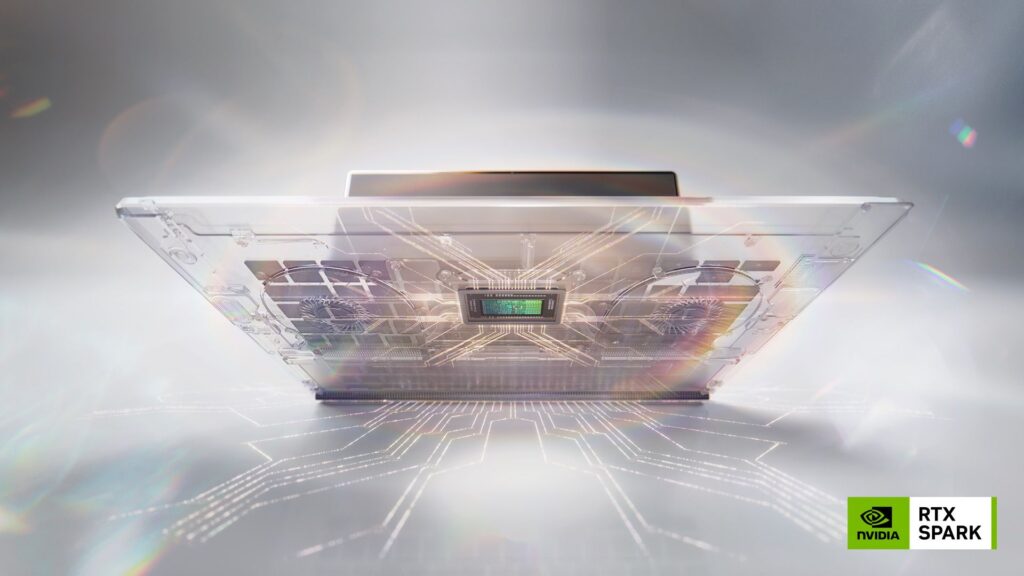
Nvidia is moving into the consumer PC chip business for the first time and has thrown the challenge at Apple, describing its new RTX Spark processor as “the most efficient PC chip ever built.”
Nvidia says its RTX Spark superchip is specifically designed to run AI agents that can work proactively on applications and run in the background as a personal “teammate.”
With the chip, Nvidia claims that users can “render ultra-wide 90GB 3D scenes with OptiX and DLSS, edit 12K 4:2:2 video with the NVIDIA Blackwell decoder, run large 120 billion parameter language models with 1 million context tokens, and play AAA games at 1440p resolution and over 100 frames per second with launch rays, DLSS and Reflex”.
The chip was announced Monday by Nvidia Chief Executive Officer Jensen Huang at the Computex conference in Taipei.
It’s a big play for a company traditionally focused on graphics cards to get into the kind of integrated silicon that runs an entire laptop. This also puts the RTX Spark on a collision course with Apple’s M5, widely considered the laptop chip to beat for running on-device AI tasks.
Like Apple’s chips, the RTX Spark is Arm-based, pairing an Nvidia Blackwell RTX GPU with a Grace CPU. It’s actually the same GB10 chip found in DGX Spark, the small “AI personal supercomputer” that Nvidia launched last year.
Microsoft’s new 15-inch Surface Laptop Ultra will be among the first machines to ship with integrated silicon. The machine features a mini-LED touchscreen, the largest haptic touchpad Microsoft has put on a Surface, and a selection of ports covering HDMI, USB-C, USB-A, SD cards, and headphones.
Configured with up to 128GB of unified memory, the Ultra can locally run AI models with up to 120 billion parameters, a figure Microsoft attributes to Nvidia, based on a theoretical performance measurement. Microsoft says it’s the most powerful Surface ever built. Nvidia says its chip will eventually appear in around 30 laptops and more than 10 desktop computers.
Microsoft says the Surface Laptop Ultra will arrive later this year. Pricing hasn’t been announced, but Nvidia has suggested that the first wave of RTX Spark machines will target the high-end end of the market.
