
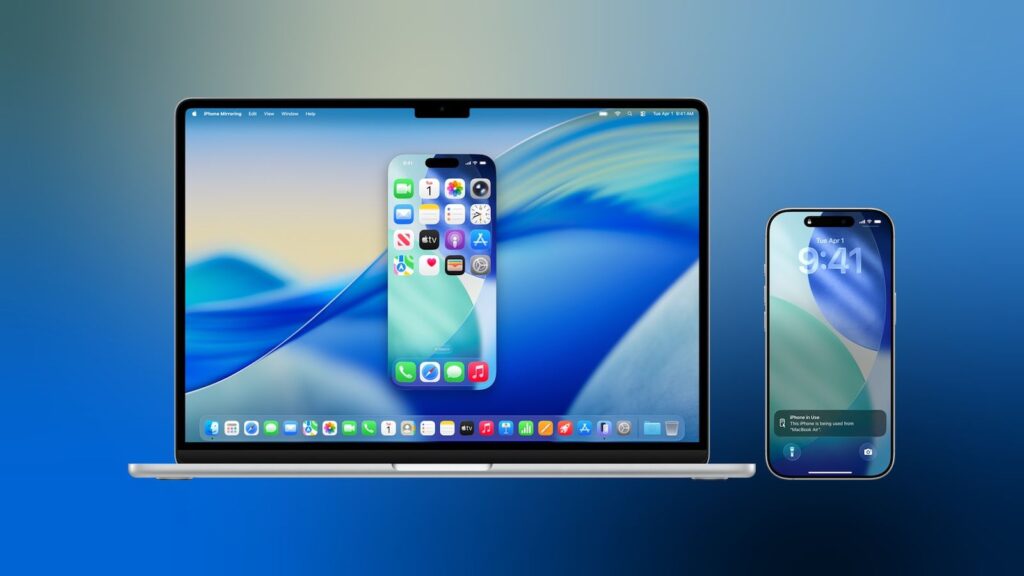
macOS 27 Golden Gate brings a major improvement to iPhone mirroring, allowing users to resize the window beyond the iPhone’s fixed aspect ratio for the first time.
Until now, iPhone Mirroring was limited to the iPhone’s native image format in a small window. Users could adjust the overall size of the window somewhat, but its proportions remained locked. With macOS 27, users can now change the aspect ratio of the iPhone Mirroring window itself, providing significantly more flexibility for workflows that rely on this feature.
The update was revealed in Apple’s Platforms State of the Union address. Multiple fixed aspect ratios appear to be available rather than freeform resizing, meaning the system snaps to the closest supported shape. Depending on the aspect ratio chosen, iPhone Mirroring renders either an adjusted version of the application’s iPhone layout, or its iPad layout, when a version is available. Aspect ratio adjustments are currently limited to iOS 27 compatible apps, which currently means only native iOS apps.
macOS 27 also adds Control Center to iPhone mirroring, joining the Home Screen, App Switcher and Spotlight as iPhone areas accessible directly from the Mac.
These improvements come alongside a broader initiative launched by Apple at this year’s State of the Platform Union conference, where developers were encouraged to move away from designing apps for fixed orientations and specific devices, and instead target what Apple described as “a dynamic range of sizes and proportions.” Apple has introduced resizable iOS apps in iPhone Mirroring and on iPad, with developers rebuilding with the latest SDK automatically enabled. A new resizable iOS simulator in Xcode lets developers test layouts on a wide range of screen sizes and aspect ratios.
This advice appears to have ramifications far beyond iPhone mirroring, with widespread speculation that this feature is essentially a veiled preparation for the upcoming foldable iPhone. Additionally, iOS 27 contains frameworks that point more explicitly to foldable hardware: “foldState” and “angleDegrees”. A third discovery, a new key that returns the total number of integrated displays on a device, suggests that Apple is also preparing the software stack for a device with multiple integrated displays. Taken together, the strings and the resizing push appear to lay the groundwork for the foldable iPhone, widely called “iPhone Ultra” and scheduled to launch alongside the iPhone 18 Pro in September 2026.
