
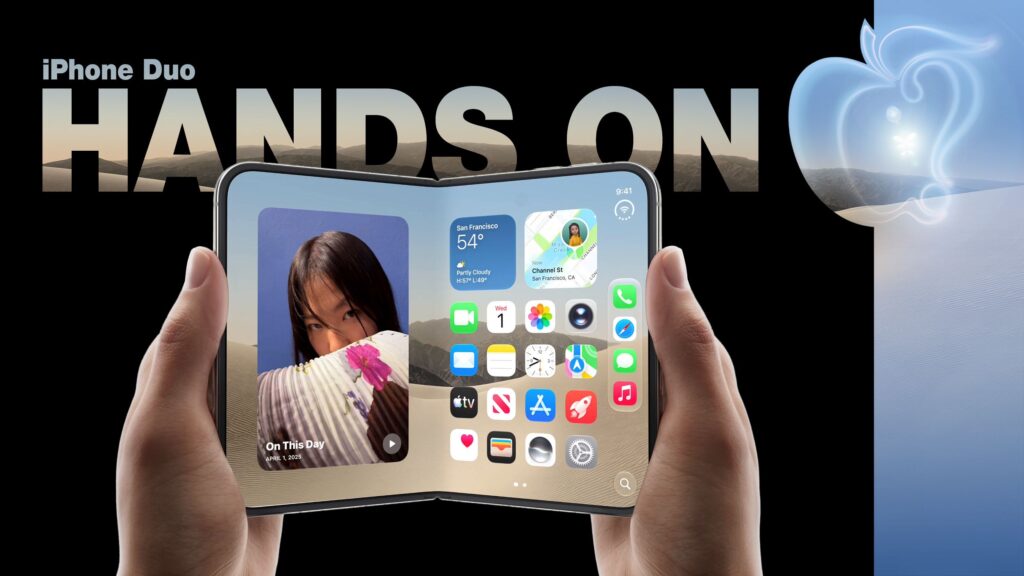
Following today’s iPhone event, Apple invited members of the media to test the new iPhone Duo. We were able to take a look and have some initial thoughts to share.
The iPhone Duo starts at $1,999, and it feels like it. This is a high-end device, thin but robust. The outer screen measures 5.4 inches, so it’s smaller than the iPhone 18 Pro when closed, but the inner screen measures 7.6 inches.
Apple used a nano-textured polymer for the interior screen, and the material reduces glare but also reduces fold visibility. The display layer features a micro-lens texture written pixel-by-pixel using maskless laser lithography for a perceptibly flat matte surface. This in effect minimizes the look and feel of the crease in the middle of the iPhone Duo.
You can still see the crease and it’s visible in some lighting, but Apple has done a better job than Samsung of hiding it. Of course, foldable creases may become more visible as a device folds and unfolds. So it will be interesting to see how the iPhone Duo holds up over time. Apple says there are viscoelastic adhesives that allow layers to slide over each other, which could help.
There is no visible cutout for the camera on the interior screen of the iPhone Duo, as Apple has placed it below the display. It’s invisible on a brighter screen, but when the display is darker, you can see a little of the camera area.
Apple knew software would be important and apps fit well in the new form factor. The main controls are on the side of the screens and there is a new vertical dock. The status bar tucks into the corner, which makes sense for a foldable device, and everything is where you want it for one-handed use.
You can run two apps side by side or two instances of the same app (like two Safari pages), but there is no option to resize them. They each occupy half the screen. Two apps can be locked together as a pair so that they are launched together in the future and you can switch to other apps.
Apps also work when iPhone Duo is open, closed, and half-folded. You can hold up the iPhone Duo and the controls will move to the bottom of the screen. iOS can adapt to the orientation and angle of the device and move content away from the fold to ensure everything is easy to operate, regardless of position. The audio also automatically tunes based on position.
StandBy works even when iPhone Duo is not charging. Simply fold the Duo in half into a tent orientation and you’ll see widgets, music, calendar, weather and more. It also works as a bedside clock and there’s even a new light alarm function.
There are only two cameras in the iPhone Duo. It has a 48 MP Fusion main camera and a 48 MP ultra-wide camera, but no telephoto camera. There’s a 2x zoom, but it’s just a cropped view from the main camera. The external display front camera is 12MP.
You can do some unique things with the iPhone Duo’s camera setup. Apple added 4K Dolby Vision time lapses, a feature that works well with the iPhone Duo because it can sustain itself for longer shots. A Smart Take option uses AI to capture a photo when everyone is in frame, so you can set it up, run over to take a group photo, and have iPhone automatically take a photo. The outer screen can display Peanuts animations to make kids smile (Kid Cue), and when you take a photo of someone, they can see themselves on the outer screen and give you feedback on the shot setup (Duo Preview). FaceTime can also use both screens and someone can join a FaceTime call with you using the external display camera, so you don’t need to come together in one camera (FaceTime Duo).
The iPhone Duo has the same A20 Pro chip as the iPhone 18 Pro and Apple’s new C2 modem which is faster and more efficient than the C1X. The C2 supports mmWave 5G speeds in the United States.
The starting price of $1,999 is for 256GB of storage. You can get up to 2TB, but that option will cost you $3,199. Pre-orders for the iPhone Duo begin on Friday, October 16, with a launch to follow on October 23.
