
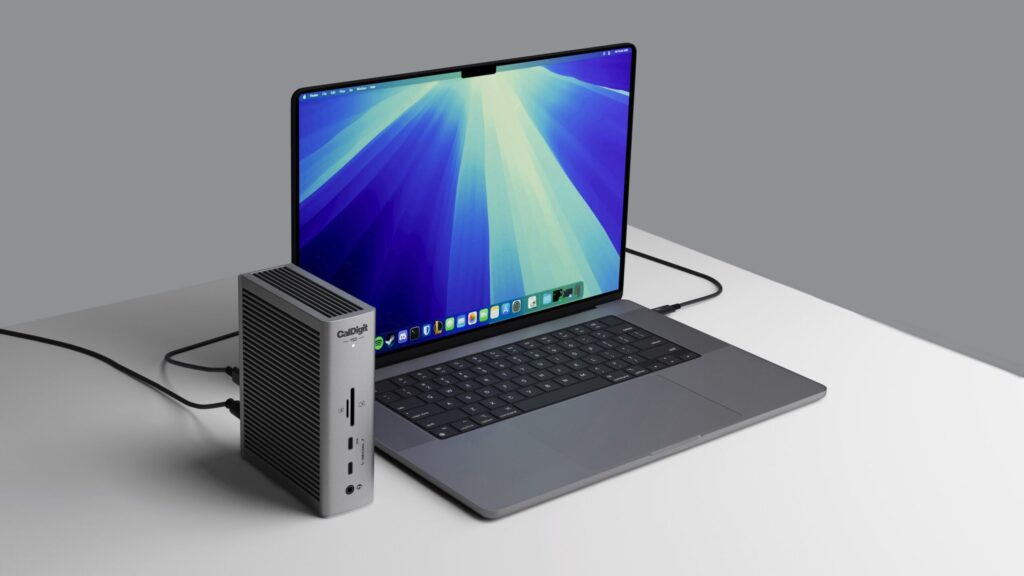
CalDigit is best known for its docks and hubs, and offers two options designed for Apple’s latest Macs. I reviewed the larger $500 20-port TS5 Plus last summer, and over the past two weeks I’ve tested the $400 15-port TS5 that launched a bit later than the premium model, as well as the smaller $250 Element 5 hub.
TS5
The TS5 is probably the Thunderbolt 5 dock I would recommend if someone on the street came up to me and asked which Thunderbolt 5 dock to buy. It’s smaller and takes up less desk space than the TS5 Plus, doesn’t have fans like some competing docks, and has a useful selection of ports. With a few exceptions, it will meet the needs of most people.
/article-new/2026/05/caldigit-ts5-front.jpg)
Thunderbolt 5 docks are ideal for Apple Thunderbolt 5 Macs (M4 Pro, M4 Max, M5 Pro, and M5 Max), but they’re also backwards compatible with Thunderbolt 3 and Thunderbolt 4 Macs, so you can use the TS5 with almost any Mac to add ports for displays and accessories.
Front ports:
- Audio jack
- USB-C with speeds of 10 Gbps and 7.5 W
- USB-C with speeds of 10 Gbps and 20 W
- MicroSD card slot (UHS-II)
- SD card slot (UHS-II)
Rear Ports:
- Audio input/output
- USB-C port with speeds of 10 Gbps and 7.5 W
- USB-A port with speeds of 10 Gbps and 7.5 W
- USB-A port with speeds of 480 Mbps and 7.5 W
- 2.5GbE
- Three downstream Thunderbolt 5 ports with 15W charging
- One upstream Thunderbolt 5 port with 140W charging
The TS5 doesn’t have dual USB controllers like the TS5 Plus, it has 2.5 Gigabit Ethernet instead of 10GbE, it doesn’t have DisplayPort, and it has three fewer USB-A ports and two fewer USB-C ports than the TS5 Plus. The TS5 has three downstream Thunderbolt 5 ports instead of two, so it beats the TS5 Plus (which only has two), but the higher-end TS5 Plus has more charging power. The TS5 Plus’s front USB-C port is 36W, as are the two downstream Thunderbolt 5 ports on the back.
/article-new/2026/05/caldigit-ts5-back.jpg)
The TS5 has the same general design that CalDigit uses for its latest docks. It’s made from a space gray aluminum material with ribs on the top and sides to dissipate heat. Although it doesn’t have a fan, it never got lukewarm in my testing, and I was surprised at how cool it stayed. The TS5 Plus ran much warmer when I tested it, but the smaller TS5 didn’t keep me warm on a freezing night.
The dock’s design fits well in a desktop setup, but like most Thunderbolt 5 docks, it won’t turn heads. I don’t have space gray gear, so the color doesn’t match my MacBook or Studio Display, but it doesn’t look too out of place. I wish accessory makers would embrace brighter, more vibrant colors, but I guess gray and black are what sells.
CalDigit’s TS5 Dock measures approximately 5.5 inches tall, 4.5 inches wide, and just under two inches thick. It fits well under a screen and can be positioned vertically or on its side. There is a separate 240W power supply, which is typical of most Thunderbolt 5 docks. In addition to the power supply, CalDigit includes a 1 meter braided Thunderbolt 5 cable, and I appreciate the cable upgrade because not all docks come with nice cables.
One thing I like about CalDigit over other dock manufacturers is the information the website provides. I think the average person probably finds hubs and docks somewhat confusing, especially when it comes to determining which displays and how many external displays a dock supports with a given Mac. CalDigit has a comprehensive table listing all Apple Silicon Macs, so it’s pretty easy to see what your Mac will support. Thunderbolt 5 supports speeds of up to 80Gbps with a bandwidth boost of up to 120Gbps for displays, twice that of Thunderbolt 4.
/article-new/2026/05/caldigit-ts5-on-desk.jpg)
The TS5 supports up to four 6K 60Hz displays, but only if you’re using a Mac with an M5 Max chip. It will also run two 8K 60Hz displays, two 4K 240Hz displays, or four 4K displays with a refresh rate of up to 144Hz. When used with a Mac M5 Pro, the dock supports up to three 6K 60Hz displays, and for Macs with earlier Pro/Max chips, the dock is limited to two displays. You can power two 8K 60Hz displays using the TS5 with an M4 Max or M5 Max Mac, while other machines end up with two 6K 60Hz displays. The base M-series chips also have different support depending on generation. The M4 and M5 chips can support two external displays up to 6K at 60Hz with the TS5, but the M1 and M2 chips only support one. The M3 is a particular exception because it supports two displays when the Mac is in clamshell mode, or one with the display open.
I tested with a Studio Display and a Studio Display XDR, both of which are 5K displays. I also tested with a Studio Display and a 32-inch OLED display at 120Hz, and had no issues with either configuration.
/article-new/2026/05/caldigit-ts5-desk-back.jpg)
There is one 5K display limitation that potential buyers should be aware of, and that is support for LG UltraFine 5K monitors. The dock does not support dual LG UltraFine 5K displays unless used with a MacBook Pro M5 Max.
I used all ports at once and performance was as expected, but I ran into an issue with the TS5 not recognizing SSDs. The SSDs I plugged into the two USB-C ports didn’t show up, but a Thunderbolt 5 SSD did the job. Unplugging the dock then plugging it back in didn’t work, but restarting my Mac did. I had the same problem intermittently, but after the first time, unplugging the dock then plugging it back in seemed to work. It doesn’t happen every time, but losing SSD connectivity through USB-C ports is a problem.
/article-new/2026/05/caldigit-power-adapter.jpg)
The TS5 has 140W host charging, which is more than enough for all Apple laptops. Thunderbolt 5 ports and 10Gbps USB-C and USB-A ports feature offline charging so you can charge accessories with the dock when your Mac isn’t connected.
Element 5 Hub
I also spent little time with CalDigit’s $250 Element 5 hub, which is an impressive little device. It’s as small as the 180W power supply that comes with it, and it’s the Thunderbolt 5 option to get if you need minimal ports.
/article-new/2026/06/caldigit-element-5.jpg)
The Element 5 hub has four Thunderbolt 5 ports (one upstream, three downstream), two USB-C ports, and three USB-A ports. 90W host charging is available for a connected Mac, which is enough to keep my 16-inch MacBook Pro charged. The downstream Thunderbolt 5 ports have 15W for accessories and the USB-C ports offer 7.5W. Like the TS5, the ports work even when the hub is not connected to a host computer.
Since there are three Thunderbolt 5 ports, the Element 5 hub can drive the same number of displays as the TS5. It doesn’t have as many USB-C ports, no SD card slots, and no audio jack, but if all you need is Thunderbolt and a few USB-C/USB-A ports, this is the way to go.
/article-new/2026/06/caldigit-element-hub-size.jpg)
I like how little space the Element 5 takes up on my desk, so much so that I might upgrade to one for long-term use. I use SD card slots, but the smaller size may be worth the sacrifice. The Element 5 measures 2.75 inches wide, 4.5 inches long, and one inch thick. It’s about the same size as my Thunderbolt 5 SSD and smaller than an iPhone. If you want compact, get this docking station.
Conclusion
I prefer the TS5 over the TS5 Plus because of the additional Thunderbolt 5 port on the TS5. I can connect two displays and still have a port for a Thunderbolt 5 SSD, which is not the case with the TS5 Plus. Unfortunately, I continually encounter issues where SSDs connected to the dock’s USB-C ports don’t work, making it difficult to recommend them to someone who needs to use it for storage purposes. I can just restart the dock, but I shouldn’t have to do that. TB5 SSDs are suitable, as are USB-C SSDs connected via a Thunderbolt port.
CalDigit’s more expensive TS5 Plus is a better option than the TS5 if you need DisplayPort 2.1, 10GbE, or an absurd number of USB-A ports (five for the TS5 Plus versus two for the TS5). The TS5 Plus also has two 10Gbps USB controllers, which is useful if you want to run multiple high-speed SSDs or drives at the same time.
If you only need a limited number of ports, I highly recommend checking out the Element 5 hub. It’s compact, but still includes four Thunderbolt 5 ports, three USB-A ports, and two USB-C ports. I don’t seem to have the same SSD problem with the TS5 Plus or Element 5.
I like CalDigit’s Thunderbolt 5 docks over competing docks from Anker and Satechi, mainly because CalDigit doesn’t include fans and its docks operate quietly. The SSD problem may be with my particular dock or my MacBook Pro, but if you’re picking up a TS5, get it from a place with a return policy just in case.
However, I like all the docks I’ve tried so far, and they’ve all been good options with no major issues. I would choose Anker’s Prime Thunderbolt 5 Dock if I wanted a dock without an external power supply, or Satechi’s CubeDock if I wanted a built-in SSD or if I had a Mac mini and wanted to match it.
Thunderbolt 4 docks are less expensive than Thunderbolt 5 options, but if you own a Thunderbolt 5 Mac or plan to buy one in a year or two, it’s worth opting for Thunderbolt 5 for the improved bandwidth.
How to buy
The CalDigit TS5 can be purchased on the CalDigit website or on Amazon for $400.
The Element 5 hub is available on the CalDigit website or on Amazon for $250.
Note: CalDigit provided Woozad with a TS5 and Element 5 hub for the purposes of this review. No other compensation was received.
