
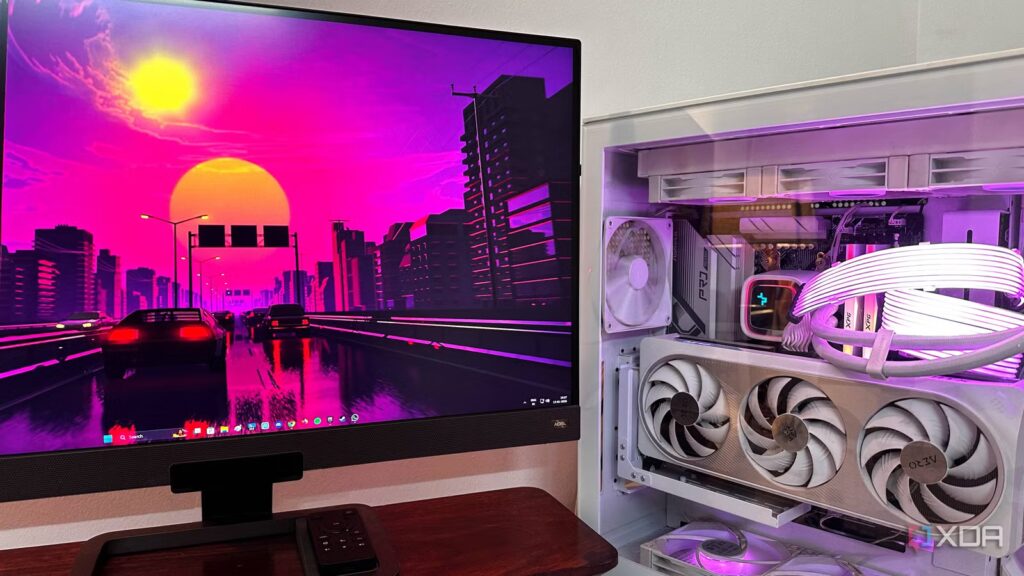
OLED displays may be more affordable than ever in 2026, but many users are still hesitant to invest in such a display due to burn-in issues. That’s why they prefer IPS monitors, thanks to an excellent combination of image quality, response time and refresh rate. I can understand the hesitation to buy a monitor that degrades over time, but the practical OLED experience has transformed over the past few years. Burn-in protection is robust, text clarity is better than ever, and even brightness levels have caught up. On the other hand, IPS displays are still plagued by the age-old problems of IPS glow, low contrast ratio, and subpar local dimming. These problems might have been tolerable in the past, but in 2026 they are inexcusable. OLED monitors are better in almost every aspect, and with the current price, even the premium OLED argument falls flat.
Fear of OLED burn-in keeps people on worse monitors for no reason in 2026
Anxiety surrounding burn-in is overblown
The dreaded IPS glow and backlight bleed
You can’t really get rid of it
I’m sure everyone reading this has seen the dirty screen effect of IPS displays, nicknamed “IPS glow.” This washed out look of IPS monitors is most noticeable in dark scenes and low lighting, or when viewing the screen at an angle. This is not so much a defect as an innate property of IPS panels, and can never be completely eliminated, no matter how well tuned and quality controlled. I spent over 8 years gaming on IPS screens and could never enjoy dark scenes during a game without internally groaning. I even had LG replace the panel on one of my old monitors because I thought the IPS glow was a little too strong. The replacement didn’t really solve the problem; it simply moved the dirty parts of the screen to different corners.
Then there’s the inevitable backlight bleed that comes with using a traditional LED monitor. This is now more of a manufacturing defect and can largely be eliminated through proper quality control. Still, this never completely goes away, and some level of backlighting is actually considered normal. As long as your monitor has a conventional backlight, some degree of bleeding will occur. Since switching to a QD-OLED monitor about six months ago, I’ve gotten rid of both of these issues. The OLED panel’s per-pixel illumination eliminates any unwanted “glow” or backlight bleed. Whatever you think of OLED displays, there’s a huge gap between them and any other panel technology. Even advanced Mini-LED panels produce halos around bright objects in dark scenes. IPS monitors are still suitable for most use cases, but they are quickly becoming a liability in 2026 as display technology evolves.

OLED burn-in is overkill, but IPS remains the productivity king
The OLED tax doesn’t get you a better working monitor
Bad contrast ratio means no true HDR
IPS and OLED aren’t even in the same league
IPS screens have always had lower contrast ratios than VA panels. The latter still looked better in darker scenes and was preferred by a significant number of users. When OLED displays became popular and people realized what per-pixel local dimming could do, things went downhill pretty quickly for IPS displays. OLED monitors have left everything else in the dust when it comes to contrast ratios. Their organic pixels could turn off completely when not in use, producing almost infinite contrast. With true, pure blacks and punchy colors, OLEDs instantly became the gold standard for HDR content. Before using an OLED display, I never understood the appeal of “true HDR,” but once I had one, I saw things in games that I’d never seen before, even when replaying older titles.
Even the best IPS monitors achieve contrast ratios of around 1000:1 or 1200:1. VA panels are significantly better at around 3000:1, but OLEDs smoke them both – since they produce perfect blacks, dividing by 0 essentially gives you “infinite” contrast. Today, you can get your hands on a 27″ 1440p 180Hz QD-OLED display from Samsung for as little as $350 during a sale. When you can get a premium HDR experience at this price, there’s really no argument for an IPS display if you value maximum picture quality.

5 Things I Wasn’t Prepared For When I Switched From IPS to OLED
OLED deserves the hype, and the asterisks are starting to be removed
Lower response time compared to OLED panels
Your eyes can follow the difference
Another problem with IPS monitors, despite their excellent gaming performance, is the lower response time compared to OLED displays. The “1ms” response time you see on almost all IPS monitors is a theoretical calculation that you never actually see in real-world gaming scenarios. Manufacturers measure this 1ms response time with aggressive overdrive settings which give rise to artifacts such as pixel overshoot and reverse ghosting. What you actually feel when gaming on an IPS display is more like a 3-4ms response time. OLED screens, thanks to self-emitting pixels, display response times of between 0.01 and 0.03 ms – no overdrive is required. The difference between 3ms and 0.03ms can be seen by your eyes and leads to the “smoother movement” that people associate with OLED displays.
In addition to naturally lower response time, OLEDs excel in motion clarity thanks to another advantage over IPS panels: effective image persistence. While IPS and OLED displays are sampler and hold displays, meaning they hold a frame in place until the next one is ready to replace it, a frame on an OLED display is visually complete as soon as it appears. IPS displays, because they are slower in terms of pixel response time, have to deal with the remaining visuals from the previous frame that your eyes can follow even when the next frame has loaded. This creates smearing and motion blur that detracts from the experience, giving OLEDs an easy win. The difference in motion clarity between IPS and OLED displays may seem unimportant at first glance, but it’s very real. And when you’re spending less than $400 on an OLED gaming monitor, the inferior motion clarity of IPS alternatives becomes difficult to justify, even if the latter costs half that of the former.

Here’s why OLEDs run smoother than other panels at the same refresh rate
At the same refresh rates, motion clarity is everything.
It’s time to put IPS screens back where they belong
For the longest time, IPS monitors remained a great choice for gaming because the OLED price just wasn’t there yet. Most people aren’t going to spend $800 to $1,000 (or more) on an OLED monitor just for deeper blacks and better HDR. However, in just a few years, this price range has literally been cut in half, highlighting all the disadvantages of IPS panels more than ever. The stark difference between IPS and OLED monitors can no longer be ignored.
