
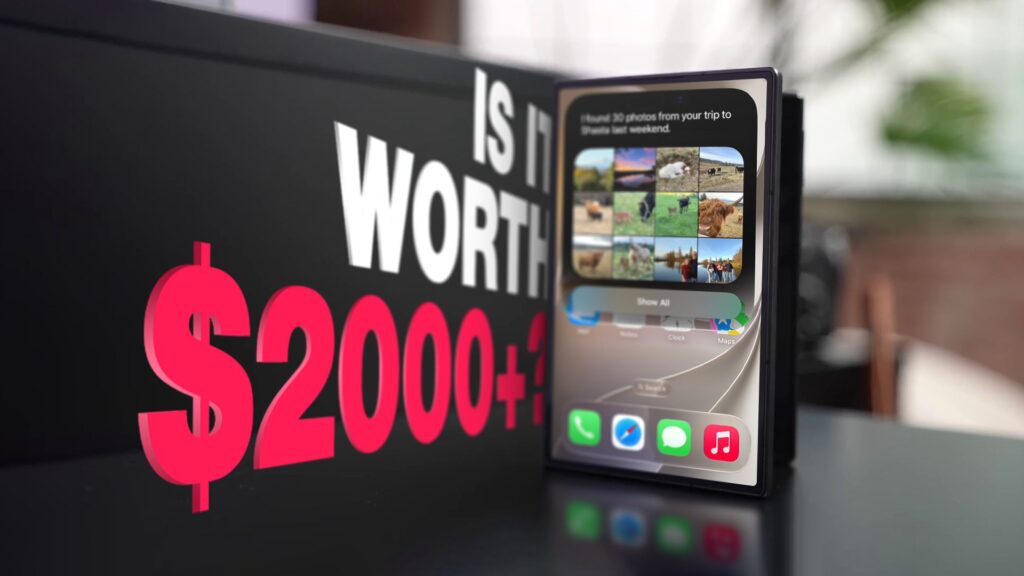
Samsung announced its latest foldable smartphones last week, and the lineup included the Galaxy Z Fold8, a device close to what we expect Apple’s foldable “iPhone Ultra” to look like when it releases later this year. Woozad videographer Dan Barbera tested Samsung’s new foldable, and the wider 4:3 screen bodes well for the iPhone Ultra.
Unlike most of Samsung’s Galaxy foldables, the Z Fold8 is wider with a tablet-like look and feel when unfolded. It measures 5.5 inches when closed and 7.6 inches when open, and those are pretty much the exact dimensions we’ve heard about for the iPhone Ultra. It’s not as tall or as narrow as Samsung’s other foldable smartphones, and it feels much more like using an iPad mini.
A larger unfolded screen is better for using two apps side by side, and it’s also a better screen size for watching videos. The 5.5-inch cover screen is perfect for checking notifications, responding to texts and emails, while the larger screen is ideal for tasks that can use more screen real estate.
Samsung’s foldable is our best look yet at what using an iPhone Ultra will be like and where it might fall short. The book format isn’t the best for vertical video, and some apps aren’t designed for the screen size. Apple is working on automatically resizing apps to match the iPad-like design, so it might be in a better position than Samsung on the software side.
Samsung’s device only has two camera lenses and not the best camera technology from the company, and that’s also what we’ve come to expect from the iPhone Ultra. A telephoto lens is unlikely, and a drop in camera quality could be one of the main downsides to choosing the iPhone Ultra over the iPhone 18 Pro this fall. It will also miss Face ID, and going back to Touch ID on a smartphone is a big change.
Apple’s design is meant to be nearly wrinkle-free with a sturdy hinge, and Samsung also used new hinge technology for the Z Fold8. Samsung says the new mechanism minimizes the crease and makes it harder to feel than with previous models, but it’s still clearly visible in certain lighting. It will be interesting to see how Apple’s foldable compares.
Samsung only launched this widescreen foldable smartphone after rumors suggested that this was the design Apple planned to use. Both Samsung and Apple have a history of adopting features after the other company comes up with something new, but Samsung seems to follow Apple more often. It appears that Apple settled on the shape and the details were revealed through leaks, leading Samsung to make a similar device. Samsung was able to come to market before Apple because Samsung has been making foldable smartphones for years.
Rumors of a book-style Apple foldable began around March 2018, and Samsung’s first foldable was released in 2019. Samsung had seven years to choose a wider design like the one Apple chose, but only launched the form factor a few months before Apple’s foldable was rumored to be arriving.
Samsung isn’t likely to stop iPhone users from choosing the iPhone Ultra when it releases, as most people tend to stick with their preferred operating system, but it could prevent Galaxy users from switching to Apple’s tablet-like design. The iPad-like 4:3 display works and the iPhone Ultra is going to sell well, even at a price of around $2,000. Samsung has priced the Z Fold8 at $1,900, but rumors suggest Apple could charge as much as $2,500.
Apple knows that the iPhone Ultra is going to shock people, and that’s probably one of the reasons why it just launched Apple Upgrade. Apple Upgrade lets you lease a smartphone for a lower monthly price than you used to get with the iPhone Upgrade Program, and it will likely help Apple sell the new iPhone.
Dan began testing hoping that the rumored price would keep the iPhone Ultra niche, but after using the Galaxy Z Fold8 and showing other people the design, he is now convinced that the iPhone Ultra will be a success.
