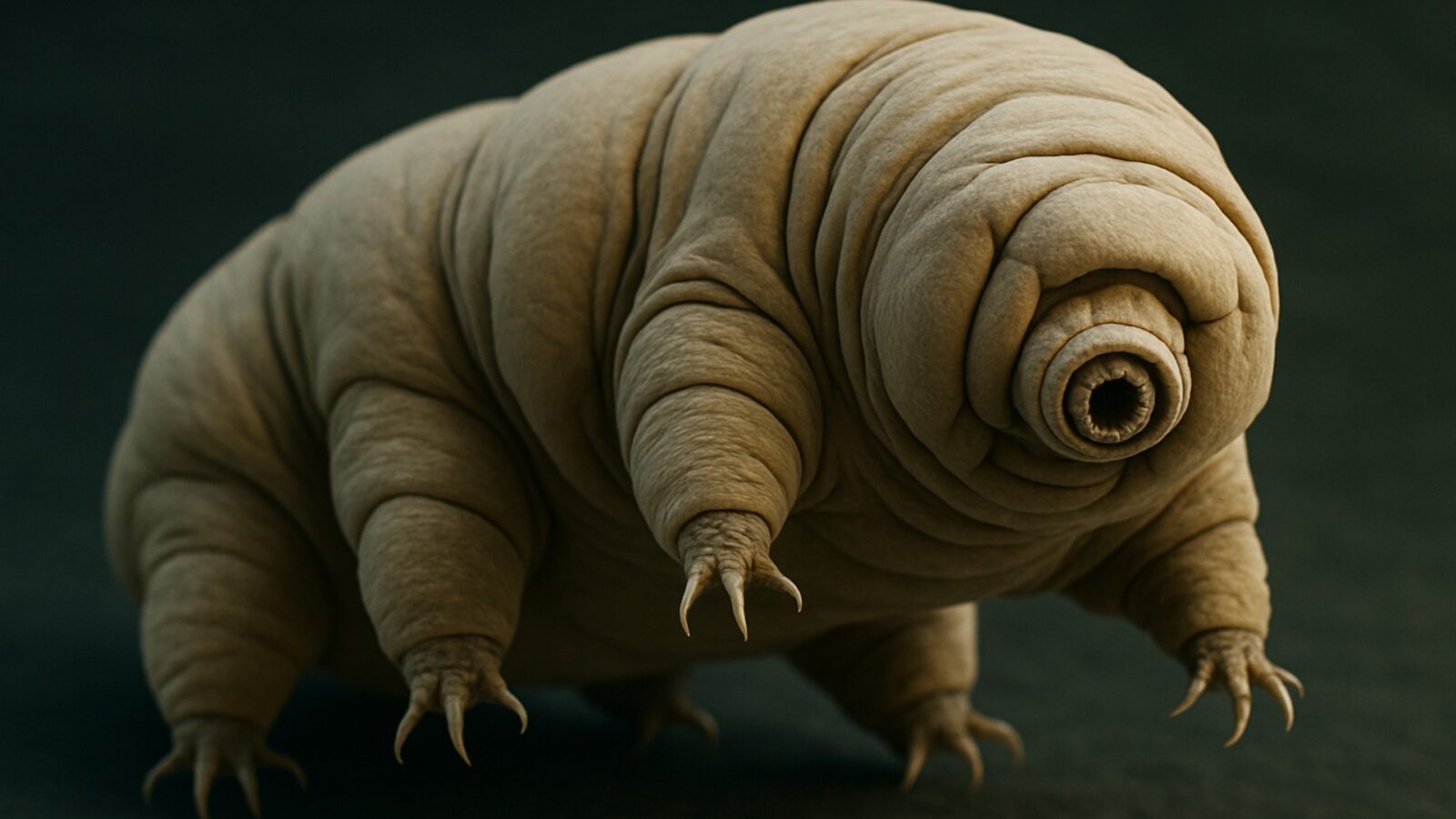
Tardigrade is a tiny animal, whose size does not exceed 1mm, it can be observed using a binocular magnifying glass. Despite its very small size, it could well be the last survivor on earth in the case of an apocalypse. Indeed, its unique characteristics allow it to survive in the least hospitable environments.
Off-norm characteristics
The body of Tardigrade is stocky, segmented and covered with a resistant cuticle, similar to that of insects, which must be driven to allow growth. Tardigrade has four pairs of short legs, each with 4 to 8 claws or adhesive pads which allow them to move slowly and cling to the surfaces. His mouth is equipped with a Bucco-Pharyngeal device which includes sharp stylics which are used to unravel the cells of plants, algae or small invertebrates to suck the nutrients. Some species of late are carnivorous and feed on other small organisms, and even other late.
Its swollen appearance gives it a miniature bear look, which earned it its water bear nickname. It is found in an incredible variety of habitats around the world, from mountainous peaks to ocean abyss, passing through the foam and lichens of our gardens. This variety of environments in which Tardigrade can evolve testifies to an impressive ability to adapt to very diverse environmental conditions.
An almost immortal animal?
The Tardigrades can survive in a hostile environment for years, even decades. Studies have shown that they manage to withstand extreme, positive or negative temperatures, and even the lack of oxygen in the space of space. This exceptional ability to survive in extreme conditions is due to a phenomenon called cryptobiosis.
Cryptobiosis is a process that allows certain animals to suspend their metabolism temporarily in order to survive an extreme environment. This phenomenon, triggered by various environmental stressers, can take various forms:
Anhydrobiosis, induced by the lack of water, is the most studied form. During this process, Tardigrade lost up to 95 to 99 % of its body water and retracts into a dry form called “tun”. This phenomenon is made possible thanks to the production of proteins specific to late (CAHS proteins). These form a gelified protective matrix (vitrification) around cells, stabilizing their structures and preventing damage.
Cryobiosis is another form of cryptobiosis which allows the Tardigrades to survive at extremely low temperatures. To do this, they produce cryoprotectors that prevent the formation of ice crystals inside their cells, thus avoiding cellular damage.
Anoxybiosis, on the other hand, is the ability to survive in poor environments or devoid of oxygen. In this state, the body of the late can swell and become rigid.
Whatever the form of cryptobiosis, the Tardigrade turns into a “tun”: its legs and its head retract, its body curls into a small sphere, and it loses a massive amount of water. In this state, its metabolism can fall at less than 0.01 % of its normal level. When environmental conditions become favorable again, for example in the presence of water, Tardigrade can be rehydrated and resume its normal metabolic activities, sometimes in just a few hours.
In 2007, Tardigrade became the first animal to resist an exposure to the space vacuum. Several specimens were taken to the Russian Mission Foton-M3. After 10 days, the majority of them had survived, and some even produced viable embryos. On earth, Tardigrade can survive for years in the state of “tun”. In 2014, in Japan, researchers have thawed and revived frozen late since 1983 in a sample collected in Antarctica, establishing a record of more than 30 years of cryptobiosis.
The myth of immortality
Despite their resistance, the Tardigrades are obviously not immortal. Apart from their cryptobiosis state, they are vulnerable to natural and human elements such as predators, diseases and other physical damage. Without entering cryptobiosis, they survive a few months and 3 years.
Even in cryptobiosis, their survival is not guaranteed. If their environment becomes hostile too quickly, as for example during a steep drop in temperatures one of rapid dehydration, some fail to enter cryptobiosis and die sufficiently quickly. The same goes for laboratory tests: a significant part of the Tardigrades does not “resuscitate”.
Immortals or not, late can help us better understand longevity in animals and humans. Laboratory studies have notably demonstrated that proteins used by Tardigrades during cryptobiosis can also increase resistance to stress of human cells. In an article published in Nature Communications in 2016, Takekazu Kunieda, a molecular biologist at the University of Tokyo, explains that a protein known as DSUP has prevented the animal’s DNA from breaking under the effect of radiation. Discovery can open the way to new solutions to improve the longevity of human cells and protect humans from radiation such as those issued by radiotherapy.