
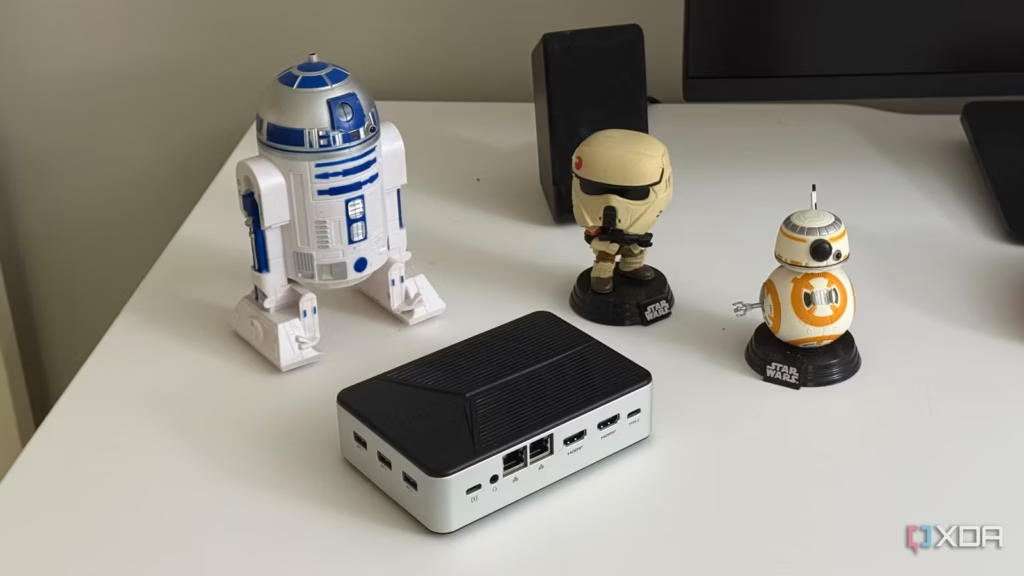
A Raspberry Pi still makes sense in many home lab setups, especially when the work is small, quiet, and specific. I’ve used them for exactly this kind of work, and I still like the idea of an inexpensive board handling a single clean responsibility without taking over the entire shelf. The problem is that my home lab hasn’t been that simple for some time. Once you start piling on containers, dashboards, monitoring tools, and storage needs, the charm of the small board starts to wear away.
Instead of looking like a slightly faster Raspberry Pi alternative, it looks like a compact home lab case that happens to be inexpensive.
This is where the GMKtec NucBox G9 surprised me. I picked mine up from Micro Center for $170, and that price immediately changed the way I thought about the Raspberry Pi’s role in my setup. My unit came with 12GB of RAM and 2TB of storage, with three additional NVMe slots always available for later use. Instead of looking like a slightly faster Raspberry Pi alternative, it looks like a compact home lab case that happens to be inexpensive.
I turned an old Android phone into a home server, and it’s more useful than my Raspberry Pi
Don’t let it collect dust in a drawer.
Four NVMe slots change what this box can become
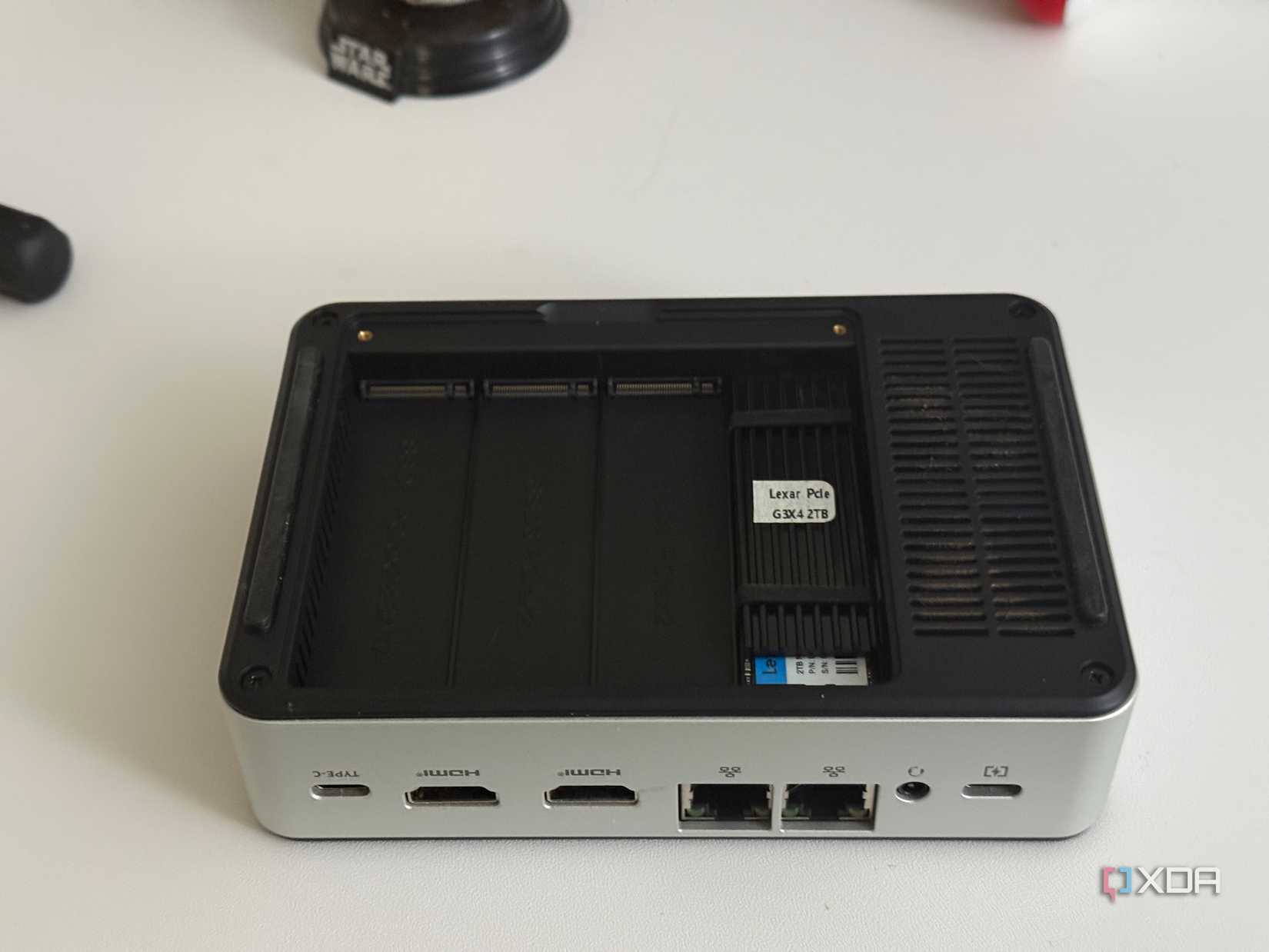
The main reason the NucBox G9 is different from a Raspberry Pi isn’t the processor. It’s storage. A Raspberry Pi can absolutely boot from NVMe or USB storage, run from an external SSD, or sit behind a tidy little case, but you still feel like you’re building around the board. The G9 starts from a more useful position because it has built-in internal NVMe storage.
Mine already came with 2TB installed, which is more than enough for a large batch of containers, local backups, configuration snapshots, logs, and temporary project data. The best part is that I still have three NVMe slots waiting for future expansion. This means I don’t have to decide right now whether this box is a small server, a small NAS, a Docker host, or a Proxmox playground. He can take on these roles without turning into a cable octopus.
It changes the feel of the whole setup. With a Raspberry Pi, storage can become the part where the neat little project starts to seem improvised. With the G9, storage seems planned from the start, and that matters when the box is supposed to stay online. I don’t need a separate powered USB hub, a hanging SSD, or an enclosure designed to solve a problem the board didn’t care about originally.
It has enough performance for real home laboratory services
The Intel N150 is modest but still very useful
The Intel N150 inside the NucBox G9 isn’t a monster processor, and that’s fine. For home lab work, I generally don’t look for the fastest chip I can buy. I want something efficient, predictable, and powerful enough to run the boring services I rely on every day. This makes the G9 a much better fit than its modest spec sheet might suggest.
The 12GB of RAM matters a lot here. A Raspberry Pi with 8 GB of RAM can run a good number of services. Still, memory headroom disappears quickly once you start adding monitoring, dashboards, DNS tools, reverse proxies, lightweight databases, and a few test containers. The G9 gives me more leeway to be messy without paying immediately. This is useful in a home lab, because half the point is experimenting without having to rebuild the entire machine every weekend.
The other advantage is that it behaves more like a normal small PC than an SBC. I can run familiar operating systems, use standard x86 software, and avoid some of the ARM compatibility quirks that still pop up at inopportune times. This doesn’t make the Raspberry Pi bad, but it does make the G9 easier to deal with as a general-purpose lab host. For $170, it’s a pretty compelling change.
A Raspberry Pi is even better for certain jobs
Small boards always win when simplicity matters most
There are still many situations where I would choose a Raspberry Pi first. If I need GPIO access, a camera project, a sensor hub, or a small box that can be hidden behind something and forgotten about, the Pi still has a strong case. It also has a massive community, endless accessories, and years of tutorials built around very specific use cases. This support network is hard to ignore.
A Raspberry Pi also helps keep expectations in check. You don’t buy one expecting it to become the center of an entire home lab, although many people try to expand it that far. Its boundaries can actually be helpful because they force you to stay focused on the project. For single-use services, this restriction may be a feature rather than a drawback.
There is also the question of power and physical simplicity. A Raspberry Pi can consume power, run quietly, and sit in places where a mini PC might seem overkill. It’s easy to underestimate how valuable this is for small automation projects or network utilities. Not every job needs internal NVMe slots, x86 compatibility, and a small pile of expansion potential waiting under the lid.
The G9 takes on more meaning once the laboratory is expanded
This reduces the compromises I was still working on

The reason I would still choose the NucBox G9 for my home lab is that my needs have grown beyond the comfort zone of the Raspberry Pi. I’m no longer just trying to run a single service. I want a box that can handle Docker containers, test environments, monitoring tools, and storage without making every new idea feel like a capacity planning meeting. The G9 gives me that space without requiring a full-size server.
It also makes the upgrade path cleaner. With a Raspberry Pi, expanding often means adding things around it. With the G9, expansion means filling the slots it already has. This seems small, but it makes the system less temporary and more deliberate. It’s much easier to trust a box that’s clearly designed to hold more storage from the start.
This is why price is so important. At $170, my G9 costs less than some Raspberry Pi versions once you add a good power supply, case, storage, cooling, and the little extras that turn the board into a reliable server. The Pi may still be the cheapest starting point in some configurations, but the fully built cost can add up quickly. The G9 avoids a lot of that piecemeal shopping and gets closer to what I actually wanted.
This exact configuration of the NucBox G9 may no longer be available, so keep that in mind if you’re looking for the same deal. This does not weaken the broader point, however. Mini PCs in this class have become much more interesting as alternatives to the Raspberry Pi, especially when they include x86 hardware, internal storage expansion, and enough RAM to run real home lab services. Even if you can’t find this exact model, it’s worth exploring similar compact systems before defaulting to another Raspberry Pi version.
This compact box easily saves its storage space
The GMKtec NucBox G9 did not render my Raspberry Pi useless. It just made the Pi seem less like the right answer for my home lab core. For small projects, GPIO work, and focused network services, I still understand why people continue to turn to Raspberry Pi boards. They are flexible, familiar, and backed by a community that has already solved almost every weird problem at the same time.
But for my current setup, the G9 is my preferred device to build around. It has enough CPU power, more headroom, internal storage expansion, and a much cleaner path to future projects. The fact that mine came with 12GB of RAM and 2TB of storage for $170 makes this decision even easier. My Raspberry Pi still has a place here, but it’s no longer the box I plan to take with the entire home lab.

- Processor
-
Intel mobile processor
- Memory
-
12 GB
This small mini PC packs four NVMe sockets for your home lab’s storage needs.
