
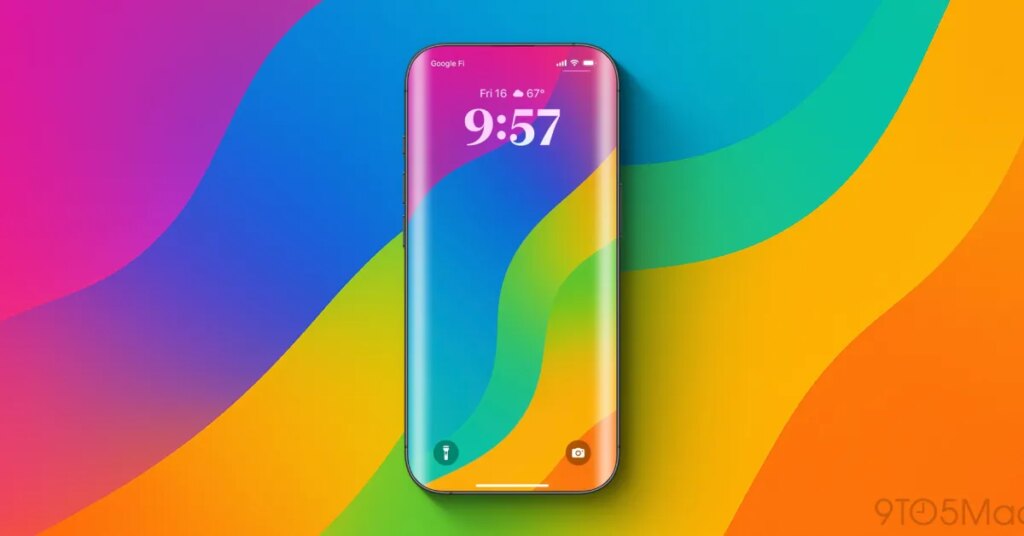
A supply chain summary report from Korea claims that the bezel-less display for the iPhone 20 is an early iteration of the technology and that there is “a possibility of screen distortion.”
The report has been updated from an earlier version, which indicated that Apple was willing to accept a “compromise” on the 2027 model, with a better version planned for 2028…
The iPhone 20, or the 20th anniversary iPhone
Early reports suggested we’d see a 20th anniversary iPhone next year in the form of a special edition modeled after the iPhone Air and the upcoming iPhone Ultra foldable phone. However, later reports indicate that the features mooted for the model could instead appear in the iPhone 20 Pro and Pro Max.
The difference between the two is simply a matter of branding – essentially, how much of a fuss Apple would make about the new design.
Either way, the design should be a big step toward the company’s long-term goal of a phone that looks like “a single sheet of glass.” The screen is said to be curved at the edges on all four sides to at least give the impression of a bezel-less screen. In reality, there may be an Apple Watch-like optical illusion where the curved edges aren’t actually part of the screen.
“Possible screen distortion”
Supply Chain Publication ETNews says Samsung and LG are both preparing to manufacture the panels for the iPhone 20.
The report suggests there will be two distinct generations of technology: one for the 2027 model and another for a 2028 update, but it’s a somewhat confusing story.
The original version of the report stated that the 2027 version would include “the possibility of screen distortion”, which would be resolved in the 2028 model. This suggested that Apple was willing to accept the “compromise” of a less than ideal screen in order to launch it next year. However, an updated version removed this last comment. We now read:
Apple plans to further evolve the “4-sided curved” screen, which it plans to apply to the 20th anniversary iPhone next year, in 2028 (…)
Currently, the display cathode layer is made of magnesium gallum alloy (Mg·Ag). In this case, there is a risk of deformation of the screen of the curved part on 4 sides and the brightness (brightness per unit area) decreases. In order to solve the problem, we plan to implement transparent electrodes by replacing the display cathode layer with indium azene oxide (IZO) in the 2028 product.
This still seems to indicate that the 2027 display has a potential problem that will be fixed in the following year’s model, but the language is more cautious.
Take from 9to5Mac
The report seems confusing enough that I won’t put too much stock into it at this point. We will obviously have a better idea of the situation later.

FTC: We use automatic, revenue-generating affiliate links. More.
