
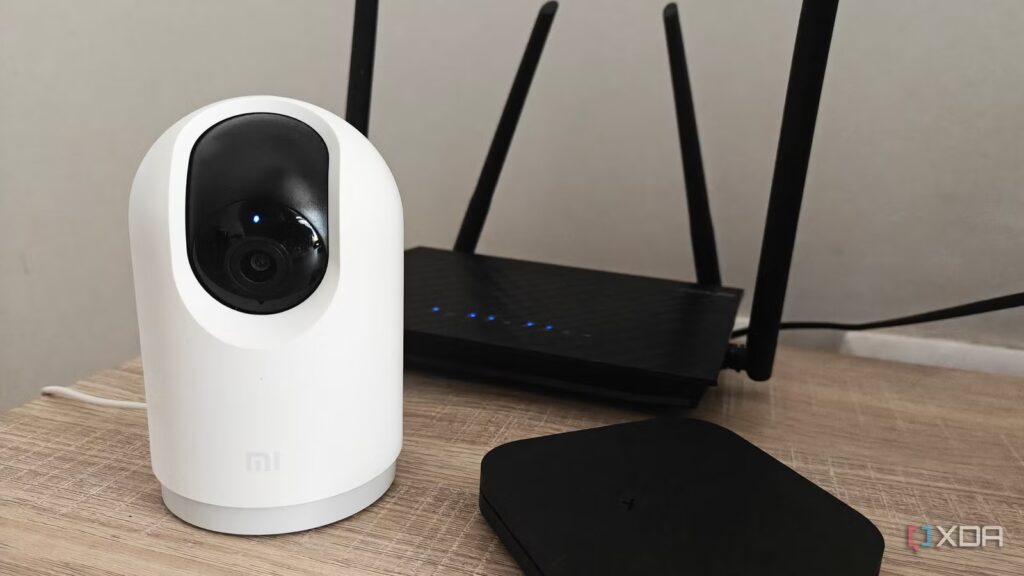
You look behind your router and you see four different white plastic boxes or smart home hubs: one for your lights, one for your sensors, one for your locks, and one for your blinds. It seems endless and frustrating. Each hub costs between $50 and $100, requires a power outlet, and requires its own proprietary app. Suddenly you feel like your smart home isn’t so smart after all.
In reality, a single $30 Zigbee USB dongle can replace all of these boxes. This not only saves space; it actually breaks down the walled gardens that manufacturers spend millions to protect. Proprietary hubs like the Philips Hue Bridge or the Aquara hub are increasingly seen as bottlenecks. They lock you into one brand, require cloud accounts, and clutter your router’s Ethernet ports. A $30 USB Zigbee adapter paired with a Home Assistant server is a universal key that unlocks all brands simultaneously.
I manage my entire smart home from a single mini PC with Home Assistant
If you told me my smart home would be controlled from a single box, I wouldn’t have believed you
Picking up a dongle will change your smart home
Protect your home from power flickers
When you pick up a Zigbee USB dongle, you actually get a universal coordinator. Setting up one of these can be a set-it-and-forget-it beast with a high gain antenna and native Matter/Thread support.
There are budget versions like the Sonoff ZB Dongle-E for under $30. It offers +20 dBm output power, meaning you can shout through walls that proprietary hubs struggle with. This means setting up this single dongle, and it can control your entire home without you having to install extension cords or multiple dongles in different locations throughout your home.
Another benefit of using this dongle is that because the adapter is plugged into your server (whether it’s your PC, Raspberry Pi, or NAS) and that server is likely on battery backup, this means your Zigbee network also stays alive during power flickers. Proprietary hubs usually crash and then take a while to restart, so this gives you an advantage.
Although the dongle is quite cheap, it’s just the ears; the software is the real brains behind the operation. To get this going, you’ll need to implement something like ZHA or Zigbee Home Automation. This is integrated with Home Assistant, making it plug-and-play. This is ideal for users who want 95% of devices to work without any additional configuration.
However, if you use devices that don’t appear in Home Assistant, you can also opt for Zigbee2MQTT (Z2M). This supports over 4,000 devices from every brand imaginable, including Lidl, Ikea, Hue and Xiaomi. The advantage of this use is that if a manufacturer releases a non-standard device, the Z2M community writes a converter within a few days. You don’t wait for an enterprise firmware update that might never arrive. You know that your devices will be immediately compatible with your dongle.
Mixing brands is the biggest advantage
You are no longer locked into a single ecosystem

By using a Zigbee dongle, you give yourself a whole new level of freedom because you can mix brands like a pro. In a proprietary hub, an Ikea bulb cannot work with a Philips Hue sensor; However, thanks to the mesh effect, this is no longer the case. With unified mesh, using a USB adapter, every mains-powered device, including bulbs, plugs and switches, acts as a router. This means your Ikea socket now boosts the signal to your expensive Hue outdoor lights. You build one giant, resilient web instead of five small ones.
The secret weapon here is binding. Zigbee Binding allows you to bind a switch directly to a light bulb at the hardware level. This means that even if your Home Assistant server is completely offline, the light will still turn on when you flip the switch. Again, the benefit of using a Zigbee dongle means that these two devices don’t need to be the same brand or even on the same proprietary hub. They all work together using the dongle.
You also benefit from privacy by taking this route. Most proprietary hubs are now pushing cloud accounts to enable out-of-home control; However, a USB adapter does not have cloud. Instead, you get local sovereignty. This means that your data remains on your local computer; your switch doesn’t need to ping a server in another country to turn on the lamp from two feet away. Everything happens internally on your own servers.
Another benefit is that when companies go bankrupt or change terms of service, like in recent sunsets, your USB home remains completely unchanged. You don’t need to start replacing devices just because the company has decided to no longer support them.
Make your smart home work for you
And it costs less than a single hub
Rather than buying gateways, it’s time to start buying coordinators. The day you move your first light bulb from a proprietary hub to a USB adapter is the day you actually start owning your smart home. Buying a budget-friendly Zigbee dongle is the best $30 you’ll ever spend because it makes your smart home feel truly smart and work for you.
