
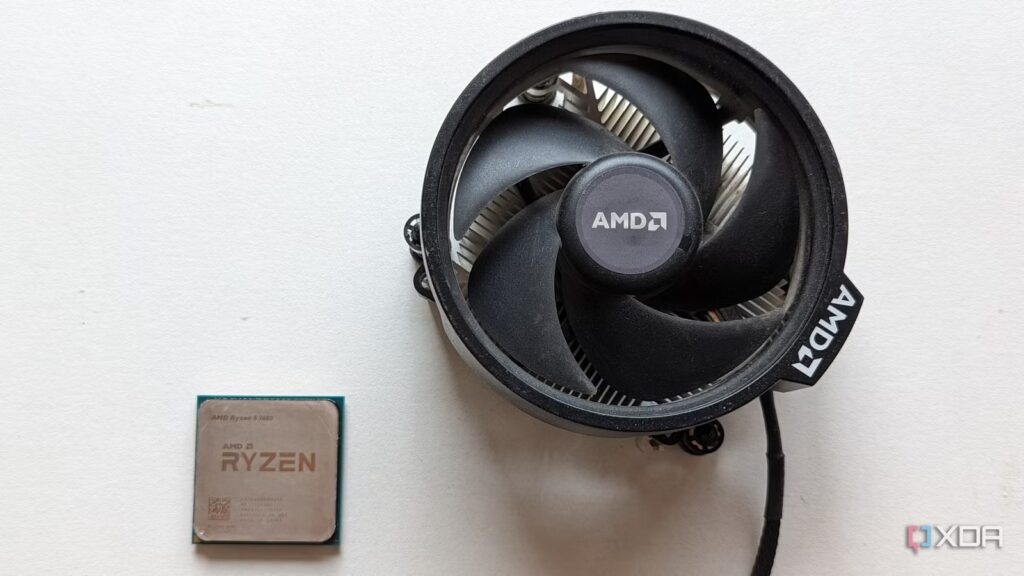
The stock coolers have earned themselves a bad reputation among PC building enthusiasts, and it’s not without reason. The original cooler designs from AMD and Intel simply weren’t good enough to meet CPU requirements, and that’s the cause of the rise of the aftermarket CPU cooler. If you were looking for performance and didn’t want your CPU to throttle under heavy thermal load, you simply needed an aftermarket cooler.
During AMD’s Ryzen revival, the original cooler made a serious comeback. The Wraith series of coolers were actually effective for non-X variants of the AMD AM4 and (for a while) AM5 processors, and offered enough cooling performance that users could put one in and forget about it. That hasn’t changed, and while AMD has backed off a bit on CPUs that include a stock cooler, if you currently have one, it’s probably just fine performance-wise, and an upgrade is probably better spent elsewhere in your build.
5 Things I Wish I Knew About Cooling Before Building My Gaming PC
This would have saved me money and a lot of hassle
Wraith coolers are better than you think
They are sufficient for the processors supplied with
While the Wraith line may not look the part, it’s pretty good for the processors that come with it. The now-discontinued Prism was rated at 140W and had some weight. It featured an all-copper contact base with four heat pipes, while maintaining a fairly low profile. It came with the top-end AMD Ryzen 7 and 9 non-X processors, and for these high-core-count beasts, it packed enough punch. If you bought a CPU that came with a Prism as an enthusiast, chances are you tossed it aside to use an aftermarket cooler, but if you did, it was powerful enough for a CPU that didn’t do any overclocking.
The same goes for the Spire and, to some extent, the Stealth, which were rated for TDPs of 95W and 65W respectively. The Spire had a similar circular body to the Stealth, but featured taller fins and a central vapor chamber, while the 65W part was relatively simple in construction. This is the closest to what we’re used to when we think of stock coolers, but when paired with a CPU with a proper TDP, it’s more than enough.
Unfortunately, AMD quietly discontinued the Prism and Spire in August 2025. All CPUs that come with a Spire now come with either a Wraith Stealth or no cooler at all. High-end processors that come with a Prism also no longer include a cooler. This discontinuation of the inclusion of coolers in boxed units is not due to the effectiveness of coolers on newer AMD processors, and was almost certainly done in an effort to reduce costs.

6 reasons why PC hardware has unfortunately lost its charm
PC components have never been more uninspiring
An upgrade would not make sense for most builders with a stock cooler
The calculations don’t match

The CPUs that came with these Wraith coolers were non-X variants of the Ryzen line. This means that overclocking is not in the equation and the thermal headroom of these chips was conservative in design.
For a 65W non-X Ryzen chip, the Stealth is definitely enough to keep things well below the TjMax threshold, and the response is similar for other coolers and their respective processors that accompany them. You’re not pushing these chips with overclocking, and the PBO does very little to increase the thermal load, so running under TjMax is almost all you can ask for. For the price of a replacement cooler, the value proposition doesn’t make much sense.
A cheap, solid replacement cooler like the Thermalright Peerless Assassin can be found for around $30. That’s not an insignificant amount of money when you’re budgeting, and it can mean the difference between getting a slightly larger SSD or being pocketed for a future significant upgrade, like a higher tier of GPU.

I Compared AMD’s Ryzen 9 9950X3D to Intel’s Fastest CPU, and It’s Embarrassing
The numbers look bad for the blue team.
Stock coolers don’t fill all the gaps
If they were perfect, no one would need anything else
All Wraith coolers can have their thermal limits exceeded if placed in particularly poor conditions, such as in hot environments or with poor airflow, but the biggest drawback is acoustics. CPU-heavy workloads that put a lot of strain on the cores, like rendering, code compilation, 3D modeling, or in a CPU-bound game, can push the fans on these coolers to speeds that result in quite a bit of noise. If these types of workloads are common in your daily workflow, fan noise from a stock cooler can become a real quality of life issue, making an upgrade to something higher performance much more reasonable. At this point it’s about keeping temperatures low for acoustic reasons and not for performance reasons.
The death of these coolers is not due to their acoustics, nor their performance, but because aftermarket coolers have become the norm, even for chips that don’t necessarily need them. The cost a consumer pays for a dual-fan, multi-heatpipe tower design has fallen precipitously in recent years, and when you add to that the generally poor reputation of stock coolers, it’s likely that a large portion of Ryzen buyers would ditch the included fan and heatsink for something else.

Is fresher stock enough in 2024?
It all depends on your processor and what you do with it
If you have one now on a non-X Ryzen, you can keep it
If performance is your only concern, don’t bother upgrading

The honest reality is that the use cases where the stock cooler really doesn’t meet expectations describe a fairly small subset of users. If performance is good and you don’t care about acoustics, your stock cooler is a good fit for your non-X Ryzen chip. If you plan to upgrade your CPU in the socket in the near future, it might be worth investing in a better cooler, but it’s not necessary in your current setup.

AMD Ryzen processors based on Zen 4 and earlier can now be “jailbroken”
If you have an old AMD Ryzen processor, you can possibly play with it thanks to a new “jailbreak”
Original coolers have a bad reputation, but the Wraith series was decent
The original coolers have come a long way from their irrelevance, and the Wraith series is the reason this road exists. AMD worked to make coolers that actually matched the chips they came with, and for some of the AM4 and early AM5s, they really were a good deal. If you currently have one in your system, you’re probably just fine and best to spend your upgrade money elsewhere.
