
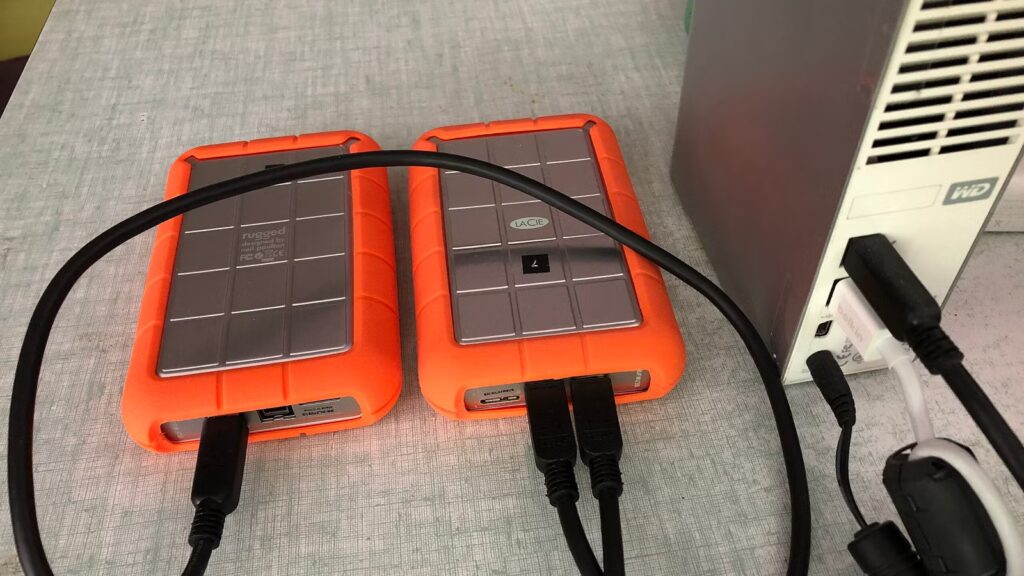
If you used a Mac in the late 1990s or early 2000s, chances are you plugged something into your computer with a FireWire cable at some point. The port looked nothing like the USB connectors most people were already accustomed to: a stubby, keyed shape that only went one way, but easy to orient once you knew what you were looking at. You plugged it in and it mostly worked without driver installation or setup dialogs. Digital camcorders, external hard drives, audio interfaces, even another Mac on the desk: FireWire handled them all with a fluidity that USB couldn’t match at the time.
For a specific set of workloads, FireWire was technically better. Higher sustained throughput, true peer-to-peer transfers, daisy-chaining up to 63 devices without a hub, and bus power on the 6- and 9-pin connectors, although the 4-pin i.LINK variant on camcorders skips power. USB had its own advantages: free licensing, simple to implement, and good enough for keyboards, mice, printers, and the long list of inexpensive peripherals that defined consumer computing.
FireWire gained performance for a narrow set of business uses and lost adoption everywhere else. By the time USB caught up in speed, FireWire had already retreated into a niche, and seeing that support disappear was frustrating if you had built your workflow around it.
FireWire has achieved a lot
Faster, cleaner and engaged in creative work
FireWire, officially IEEE 1394, began as an Apple-led project in 1986 and became a multi-vendor standard with contributions from Texas Instruments, Sony and others before being ratified in 1995. The goal was to handle the data rates demanded by Apple’s creative software, without the SCSI terminators and jumpers that professional setups relied on. FireWire 400 offered a theoretical maximum of 400 Mbps, about 33 times faster than USB 1.1’s 12 Mbps. USB 2.0 will later hit 480 Mbps on paper, but the spec sheet doesn’t tell the whole story.
The real difference came from the architecture. USB required a host controller at the center of everything, with all devices in a tree structure. FireWire used a peer-to-peer bus in which devices negotiated transfers between each other rather than going through a single host. In practice, this meant lower CPU overhead and better sustained throughput for storage, audio, and video, although actual performance depended on controller silicon, drivers, DMA support, and how a given device implemented the specifications. Hot plugging worked, you could chain up to 63 devices, and you could connect two Macs with a FireWire cable and use one as an external drive for the other, a feature Apple called Target Disk Mode. FireWire 800, introduced in 2003 with a new 9-pin connector, added full-duplex signaling on top, useful for storage although reserved-bandwidth isochronous mode was more important for camera capture.
If you wanted to edit video in the early 2000s, FireWire wasn’t optional. Digital camcorders from Sony, Panasonic, Canon and others used it as their primary output. The DV format ran at around 25 Mbps for video, with a total stream closer to 36 Mbps once audio and overhead are included, already three times USB 1.1’s 12 Mbps cap. The FireWire 400’s 400 Mbps headroom handled it without issue, and ripping the footage into Final Cut Pro or Avid meant you needed a FireWire port. Audio production followed the same pattern: interfaces from Focusrite, MOTU, RME and others offered low-latency multi-channel recording. USB struggled to match, helped by isochronous mode reserving bandwidth and sync slots so that audio data had a guaranteed delivery window.
Apple’s decision to integrate FireWire into its Mac lineup has cemented its status. Most iMacs, Power Macs, iBooks, and PowerBooks of the era came with built-in FireWire, sometimes with two ports. The first iPod depended on it for the experience Apple wanted: USB 1.1 didn’t provide enough bandwidth or power for fast syncing and charging, so the original iPod came with a FireWire connector and remained that way until USB 2.0 came along. This was both FireWire’s strength and weakness. It became synonymous with professional creative work on the Mac, but if you weren’t in that market you didn’t really need it, and USB 2.0 was good enough for everything else.
USB caught up and FireWire couldn’t keep up
Cheaper, simpler and ultimately faster too

For all its technical advantages, FireWire had some inherent disadvantages, starting with cost. It required dedicated controller chips on the host and device side, which was more expensive to manufacture than simpler USB controllers. Apple announced a FireWire licensing fee of $1 per port in 1999, which the industry strongly rejected; Apple revised it down to around 25 to 50 cents per system shortly after, but the damage to the standard’s reputation in the PC industry was already done. Implementing USB was free, which made all the difference when manufacturers were trying to hit a target price. The cables and connectors didn’t help either: thicker, bulkier, and more expensive than USB, with 4- and 6-pin variants on consumer equipment and 9-pin on FireWire 800, meaning there was enough variety to cause confusion even within FireWire’s own line. A bit like today’s sound USB4when you think about it.
Microsoft support was another piece of the puzzle. Windows had FireWire drivers, but they weren’t as mature or as well integrated as macOS. USB offers better native support from more hardware and peripheral manufacturers. Once Intel threw its weight behind USB 2.0, the PC side moved on almost entirely. FireWire remained on Macs for years, but the PC world had already made up its mind.
By the mid-2000s, USB had closed the gap. USB 2.0’s overall throughput of 480 Mbps was higher than FireWire 400’s 400 Mbps, although in real-world sustained transfers FireWire 400 often offered better throughput and lower host overhead, which is why creative professionals stuck with it well after USB 2.0 became widespread. USB 3.0, launched in 2008, brought 5Gbps, full-duplex SuperSpeed signaling, and higher bus power, eventually overtaking FireWire on workloads where it had remained in the lead, and Apple moved on as well. The fifth-generation iPod dropped FireWire syncing for USB in 2005, the MacBook Air launched in 2008 without any FireWire ports, and over the next few years Apple’s lineup dropped FireWire one model at a time. The last new Mac designs to include FireWire were around 2012, by which time Thunderbolt had become the spiritual successor.
The final blow came in 2025, when macOS 26 Tahoe Removed FireWire driver support. Apple hasn’t made a big announcement on this; The change came about when users noticed that older FireWire devices no longer worked. After nearly thirty years of compatibility, it seemed that FireWire was truly over.
FireWire deserved a better ending
It just wasn’t in the cards

There’s a specific type of frustration that comes with using technology that’s better than the alternative for what you’re doing, and seeing it lose anyway. FireWire was neither faulty nor half-baked. It was well designed and reliable in its niche. The creative professionals who relied on him knew it. They failed to convince the broader market to care because the broader market had different priorities.
USB won because it was cheaper, simpler, and more universal, and those are the parameters that matter when you’re designing a connector for mass adoption. Unfortunately for FireWire, it was optimized for a specific use case and, in doing so, optimized itself outside of the market that could have funded its future. The cheapest feasible option tends to beat the technically superior option, especially when the cheap option is good enough.
FireWire is the result of good engineering that felt like an upgrade at the time you were using it, and it still does for anyone who plugs a FireWire drive into a machine from twenty years ago and remembers what USB was back then. Good engineering doesn’t always win on its own, and for those who relied on FireWire, that’s the most frustrating part.
