
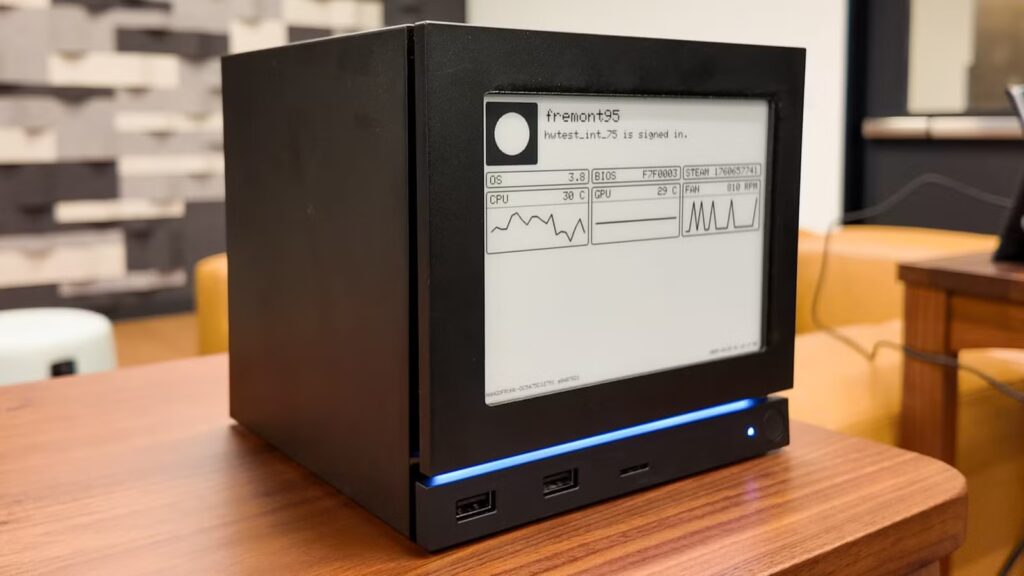
Valve’s Steam Machine announcement had sent the company’s fans into a tizzy as they eagerly awaited a Steam console/PC hybrid to enjoy their entire library on their TV. Valve marketed the Steam Machine as a PC six times more powerful than the Steam Deck, providing the SteamOS experience at 4K 60 FPS, although its internals cast heavy doubts on that claim. While Valve essentially created the PC handheld market with the excellent Steam Deck, the Steam Machine seems less like a slam dunk. Its launch is still a ways away, but considering what we know about it, and how the PC hardware market has transformed in the last six months, all signs point to the Steam Machine being dead on arrival. Valve is trying to create a new market, but the delay in the Steam Machine’s launch might be the biggest reason it loses out on that very market.
The Steam Machine may be the biggest hardware con in 2026
It wants to be in your living room, but it can’t explain why
The Steam Machine was already not worth the hardware inside it
Valve is banking on SteamOS
It was great to see Valve announce not only a new Steam Machine, but also the Steam Frame VR headset and a new Steam Controller. News of new hardware from Steam was always going to get people talking, and Valve got all the publicity it hoped for. However, the Steam Machine’s hardware specs became a huge talking point, and not for the reasons Valve would have wanted. We already know that Valve plans to outfit the Steam Machine with a 6-core, 12-thread semi-custom AMD Zen 4 CPU and a semi-custom RDNA 3 GPU with 28 CUs, 8GB of VRAM, and a 110W TDP. To compare it to a PC configuration, this will essentially have the horsepower of a Ryzen 5 7600 and an RX 7600. With 512GB of NVMe storage (starting) and 16GB of DDR5 RAM (non-upgradable), the Steam Machine is nothing more than an entry-level PC.

Quiz
Steam Machines and the launch that missed its moment
Trivia challenge
Valve had big dreams for living room PC gaming — find out how much you know about the Steam Machine’s rocky rise and fall.
ValveHardwareHistorySteamOSGaming
In what year did Steam Machines officially launch at retail?
Correct! Steam Machines launched at retail in November 2015, alongside the Steam Controller and Steam Link. The launch came after several delays, pushing the hardware out well past its originally intended window.
Not quite. Steam Machines hit retail shelves in November 2015. The launch was delayed multiple times from earlier target windows, which only added to the momentum problems the platform already faced.
Which major console launched in the same holiday season as Steam Machines in 2015, making competition especially fierce?
Correct! The Xbox One had launched in 2013 but was a dominant living room presence during the 2015 holiday season, alongside the PS4. Steam Machines were squeezed between well-established consoles with massive game libraries.
Not exactly. While the Xbox One launched in 2013, it was a powerful, entrenched competitor in the living room during Steam Machines’ 2015 debut. The PS4 was equally dominant, leaving little oxygen for Valve’s newcomer.
What operating system did Steam Machines run out of the box?
Correct! Steam Machines shipped with SteamOS, Valve’s own Debian-based Linux distribution designed for the living room. The OS featured a Big Picture interface and was built to make Linux gaming more accessible.
Not quite. Steam Machines ran SteamOS, a Debian-based Linux OS developed by Valve specifically for the platform. It was designed around the Big Picture interface, though its Linux roots severely limited the available game library at launch.
What was one of the biggest practical disadvantages Steam Machines faced compared to Windows PCs at launch?
Correct! Because SteamOS was Linux-based, a significant chunk of the Steam library — which was overwhelmingly Windows-native — simply would not run on it. This was a crippling disadvantage that made the pitch to consumers very hard to sell.
Not quite. The core problem was that SteamOS ran Linux, and the vast majority of Steam’s game library at the time was built for Windows. Buyers expecting access to their full Steam libraries were often disappointed, which fatally undermined the platform’s value proposition.
Which company manufactured one of the most well-known Steam Machine models, the Alienware Steam Machine?
Correct! Alienware, a subsidiary of Dell, produced one of the flagship Steam Machine models. It was a compact, console-sized PC that drew considerable attention, though its pricing and SteamOS limitations still held it back.
Not quite. The Alienware Steam Machine was made by Alienware, which is a brand owned by Dell. It was among the most prominent Steam Machine designs, offering a sleek, living room-friendly form factor, but it couldn’t escape the platform’s wider problems.
What companion input device did Valve launch alongside Steam Machines to replace a traditional mouse and keyboard?
Correct! The Steam Controller launched alongside Steam Machines in 2015. It featured two trackpads instead of traditional thumbsticks, aiming to replicate mouse-like precision for games not designed for controllers. Reception was mixed but it built a cult following.
Not quite. Valve launched the Steam Controller alongside Steam Machines. It used haptic trackpads instead of analog sticks, an unconventional design meant to bridge mouse-and-keyboard games and couch gaming. It was discontinued in 2019 when remaining stock sold out rapidly.
Valve first publicly teased the Steam Machine initiative with a series of mysterious announcements in what year?
Correct! In September 2013, Valve made three consecutive announcements — SteamOS, Steam Machines, and the Steam Controller — building significant hype. The two-year gap before the actual retail launch in 2015 hurt momentum considerably.
Not quite. Valve announced the Steam Machine initiative in September 2013 with three dramatic daily reveals. By the time the hardware actually launched at retail in November 2015, much of the initial excitement had faded, contributing to the platform’s underwhelming reception.
Which later Valve product is widely considered the spiritual successor to the Steam Machine concept?
Correct! The Steam Deck, released in 2022, is broadly seen as the evolution of Valve’s Linux gaming ambitions. It runs SteamOS, uses Proton to massively expand Linux game compatibility, and succeeded where Steam Machines struggled by being a portable, affordable, self-contained device.
Not quite. The Steam Deck, launched in 2022, is considered the true heir to the Steam Machine concept. Crucially, Valve solved the game compatibility problem with Proton, a compatibility layer that lets Windows games run on SteamOS — the exact issue that sank Steam Machines.
Your Score
/ 8
Thanks for playing!
The semi-custom nature of the CPU and GPU doesn’t mean AMD engineered new silicon for Valve, so the expected performance of the Steam Machine should be pretty much in line with that of the RX 7600 and Ryzen 5 7600. That doesn’t sound great, to be honest. There’s a fair bit of assistance that FSR upscaling will lend to the entire experience, and Valve’s lightweight SteamOS environment will lack the overhead Windows is known for. That said, during the announcement window, Valve made it clear that it would price the Steam Machine like a PC, not a console. So, don’t expect them to eat heavy losses just to make the device affordable for the masses. The consensus, way before hardware prices exploded, was that the Steam Machine would cost well above $700. For an entry-level PC that runs SteamOS and comes with a controller, $700–$900 sounds like a steep ask.

There’s a good chance the Steam Machine is DOA – and that’s okay
Even under perfect market conditions, the Steam Machine had an uphill battle to climb
The delay will push fans toward consoles and DIY alternatives
Not everyone will be willing to wait
Valve had announced “early 2026” as the launch window for the Steam Machine, but the volatile PC hardware market over the last six months naturally delayed that. Although the company still targets to ship each of the three announced products in H1 2026, the significant delay has gamers considering alternatives. Consoles like the PS5 and PS5 Pro have also seen recent price hikes, but considering GTA VI comes out in November 2026, there’s no lack of gamers rushing to buy these devices. Besides, gamers who want a couch gaming experience can see themselves spending $650–$900 on a PS5/PS5 Pro, when the Steam Machine is also expected to cost that much.
Enthusiasts are already going the DIY route, creating their own Steam Machine by installing SteamOS, Bazzite, or some other Linux gaming distro on capable but affordable hardware. Thanks to gaming on Linux having a moment, compatibility and performance have never been better, and many people are confident they don’t need to wait for the Steam Machine anymore. And companies like Playnix are already selling their versions of the Steam Machine, with sales apparently going strong despite the Playnix Console costing around $1,140.
Then, there’s always the option of building a budget Windows gaming PC. Even with the inflated RAM, storage, and GPU prices, you could reasonably build a PC stronger than the Steam Machine for not much more. For instance, a Ryzen 5 7600 and RX 9060 XT 8GB build with a B650 motherboard, 2x8GB of DDR5-6000 RAM, a 1TB Gen4 NVMe SSD, and the rest of the parts can be put together for around $1,100 even in this market. The RDNA4 GPU is around 35% faster than the RX 7600, and the 8GB VRAM is the same as that of the Steam Machine. Plus, your budget PC will be fully upgradable, not to mention the added flexibility to use it for much more than just gaming.

Valve’s Steam Machine delay forced me to DIY, and honestly it’s better this way
There’s no need to wait
The inflated price will further alienate its target market
Even dedicated fans won’t stomach the AI-driven price hikes
Valve made a reputation for offering value-for-money hardware with the Steam Deck. At the time, the PC handheld market was non-existent, and Valve was able to sell the Steam Deck in droves, thanks to its affordable pricing. This time, however, the Steam Machine isn’t an entirely novel offering going up in an undisputed market. It needs to nail the pricing if it wants to create a niche for the SteamOS console experience. The company has proved that SteamOS can work for desktop games, but without the right price for the Steam Machine, the device will simply fail to convert console and PC gamers alike.
Valve isn’t going to sell the Steam Machine at a loss as Sony and Microsoft do, which has already made people wary of the launch price. Now, with the AI hardware crisis skyrocketing the prices of RAM, SSDs, and GPUs, the initial price Valve had in mind will certainly go up. The devoted fans who were ready to pay a slight premium for a hybrid Steam console will rethink their decision when that premium grows larger. The average gamer may not be comfortable building their own Steam Machine, but they’ll also not go out of their way to buy a console when it performs way worse than similarly priced hardware. If Valve decides to delay the launch beyond H1 2026 in hopes of seeing lower hardware prices, the market will have moved on to something else — another console, a DIY SteamOS PC, or a conventional Windows gaming rig. As it stands, the road ahead doesn’t seem rosy for the Steam Machine.

Don’t save for a Steam Machine if you have an AM4 PC
Why pay more for less when you can have better?
The Steam Machine will be the right device at the wrong time
I have nothing against the Steam Machine. I’ll not buy it myself as I have a decent gaming PC that I also use occasionally with Steam Link to enjoy couch gaming. That said, it’s a great device that promises a seamless, console-like experience for millions of PC gamers. If priced right, it can be a huge success, but Valve will most likely not be able to do that. The economics of the PC hardware industry this year (or the next) aren’t conducive anymore, and the Steam Machine will likely suffer accordingly.
