
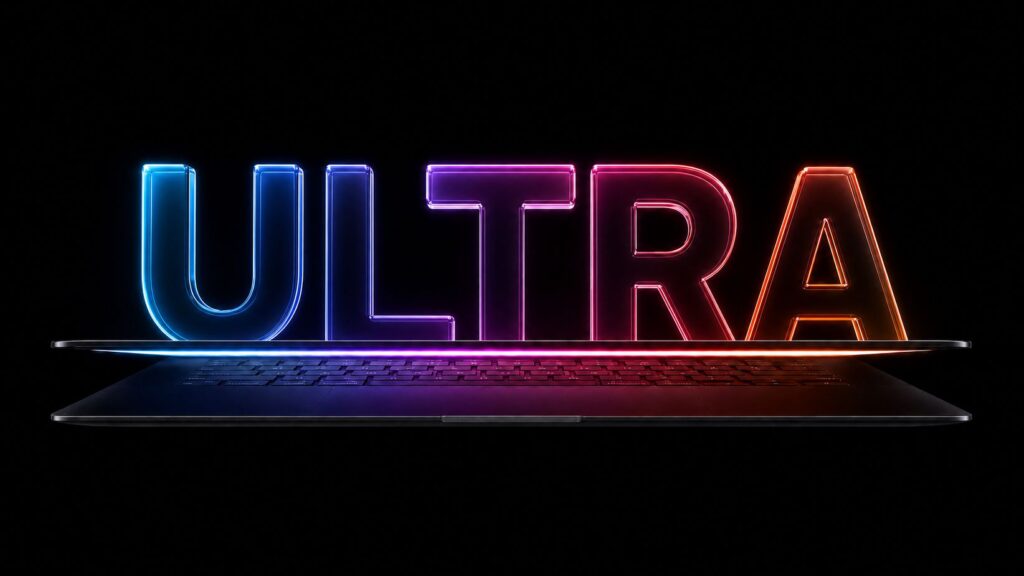
The first redesign of Apple’s high-end MacBook in five years is expected to arrive in the near future, bringing a series of firsts to the Mac.
BloombergMark Gurman of expects the laptop to arrive between late 2026 and early 2027, with the latter window now looking more likely due to the global shortage of memory chips. Analyst Ming-Chi Kuo expects mass production to begin by the end of 2026.
Apple last redesigned the MacBook Pro in 2021 with the M1 Pro and M1 Max models, so this would be its first new premium laptop design in at least five years. Here are all the rumors regarding the device so far:
- “MacBook Ultra” marking: Apple has reportedly decided to release two new “Ultra” products over the next year, the foldable iPhone and this laptop, which would set a higher level than the MacBook Pro for the first time. The name is unconfirmed and Apple could theoretically still use the “MacBook Pro” branding, but for now, “MacBook Ultra” seems very likely.
- OLED screen: The MacBook Ultra is expected to be the first Mac with an OLED display, replacing the mini-LED backlighting used in current MacBook Pro models. It should offer richer colors, a higher contrast ratio with true blacks, greater brightness and improved power efficiency, since individual pixels turn off rather than dim. The laptop would use hybrid OLED technology combining an oxide TFT backplane with a dual-battery tandem OLED structure, the same approach used in the iPad Pro, providing longer panel life.
- Touch screen: The device is expected to be the first Mac to support touch input directly on the screen, ending years of Apple’s resistance to the idea. Kuo first claimed the panel would support touch, Gurman corroborated it, and the Weibo leaker known as “Instant Digital” claims the feature is now confirmed. Apple is apparently not positioning the machine as a touch device like the iPad, but rather allowing customers to switch interchangeably between touch, trackpad, and keyboard, in what Gurman describes as “touch, not touch first.” The laptop would remain a classic clamshell, with the keyboard and trackpad retained and without a detachable or convertible design.
- macOS optimized for touch: Apple is reportedly reworking macOS so that commands adapt to the input method used. Tapping an item in the menu bar would apparently bring up a larger set of optimized touch controls, and the system would benefit from iPad-style gestures including pinch-to-zoom and quick scroll. Touch options would be integrated throughout the operating system rather than limited to a handful of apps.
- Reinforced hinge: Apple probably plans to add a reinforced hinge so that the screen does not wobble when pressed. The MacBook Pro’s current hinge moves easily and doesn’t tilt particularly backwards, which could be a problem on a machine designed to be pushed.
- Perforated camera: The “notch” should disappear, replaced by a much smaller punch-hole camera at the top of the screen. The change was first indicated by a roadmap from research firm Omdia and has since been corroborated by Bloomberg. Losing the notch would add visible screen area and free up the menu bar space it currently encroaches on, bringing the design closer to an uninterrupted edge-to-edge display.
- Dynamic Island: The cutout should expand digitally to form a dynamic iPhone-style island. It would be interactive and expand contextually based on the Mac app or feature being used, bringing up things like Siri, low battery alerts, and AirPods connection indicators in the area surrounding the camera.
- M5 Pro and M5 Max chips: The laptop is now expected to ship with the existing M5 Pro and M5 Max chips already found in the current MacBook Pro, rather than the ‘M6 Pro’ and ‘M6 Max’. Apple has apparently abandoned the M6 Pro and M6 Max altogether, instead accelerating the M7 Pro and M7 Max chips that are said to be optimized for AI-intensive workloads with improved neural accelerators, graphics enhancements, and increased memory bandwidth. A second generation model equipped with these chips would be planned for the end of 2027.
- Slimmer design: The MacBook Ultra should be noticeably thinner and lighter than the current MacBook Pro. Moving away from mini-LED backlighting should in itself help slim down the lid. So far, there’s no indication that Apple intends to remove ports like HDMI, MagSafe, or the SD card slot to achieve this, which was a deeply unpopular move last time around.
- Two display sizes: The laptop is expected to be offered in 14- and 16-inch sizes, mirroring the current MacBook Pro lineup, with the two models apparently named K114 and K116.
- Thinner glasses: Research firm Omdia says Samsung Display will deliver 14.3-inch and 16.3-inch panels, slightly larger than the 14.2-inch and 16.2-inch displays on current models, suggesting thinner bezels around a slightly larger screen. A February report from Bloomberg indicated that the overall screen size should not change compared to the MacBook Pro.
- Integrated Cellular: Apple is reportedly at least considering built-in cellular connectivity for future Macs, which would be a first for the platform. If the plan comes to fruition, the MacBook Ultra would likely use Apple’s existing C1X modem or its next-generation C2 modem for 5G and LTE. This is apparently the most uncertain feature on this list.
There are already signs of the touchscreen MacBook in Apple’s software. macOS 27 Golden Gate hints at the machine in at least three ways: it adds direct touch input to Sidecar, allowing users to tap and interact with macOS elements with a finger on an iPad; it introduces iPhone-style refreshing to apps including Safari, Mail, News, Podcasts, and Calendar; and its new “Search or Ask” Siri interface in Spotlight adopts a dark, pill-shaped design that would sit naturally around a dynamic island.
There is some discomfort for buyers. The first MacBook Ultra looks set to combine Apple’s most ambitious Mac redesign in years with silicon that’s already been on sale for months, but a successor with much more advanced chips could follow less than a year later.
The price remains the unknown, but it risks being high. Apple raised prices for its Mac line in June, and the 14-inch MacBook Pro now starts at $1,999, rising to $2,499 with the M5 Pro chip, while the 16-inch model starts at $2,999. The MacBook Ultra should stand above them all.
