
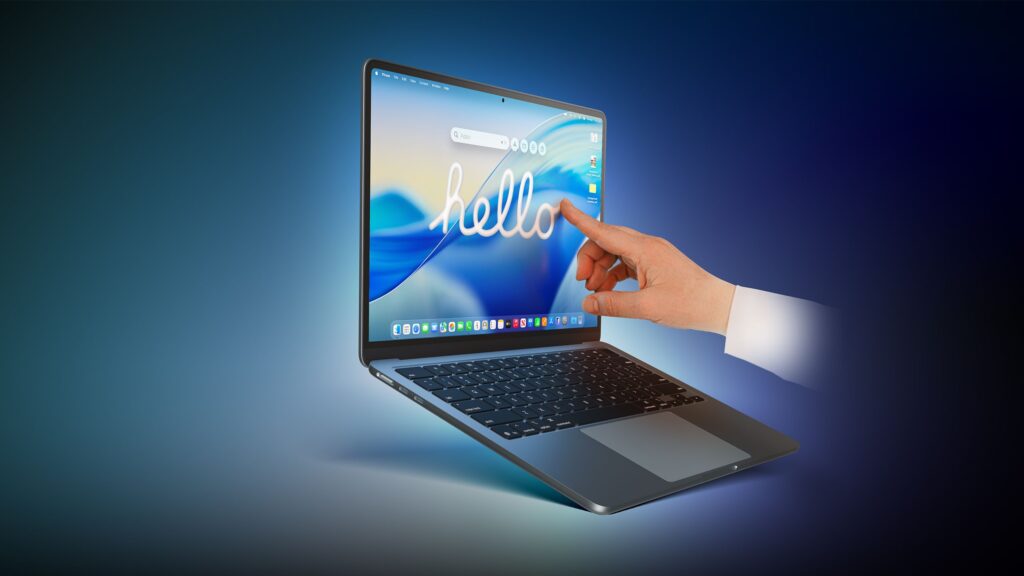
Apple’s first touchscreen MacBook is now “100% confirmed,” according to the prolific Chinese leaker known as Instant Digital, which appears to have inside information from supply chain sources. The leaker made his definitive statement this morning in a post on Weibo.
Instant Digital has a good history when it comes to Apple rumors and has provided surprisingly accurate information in the past. So it’s always interesting to note what they have to say about Apple’s plans. This claim is also supported by several recent reports.
The recurring rumors about Apple’s development of the touchscreen MacBook actually date back a few years. In January 2023, BloombergMark Gurman of , said that a MacBook Pro with an OLED display would be the first touchscreen Mac. The machine was initially planned for 2025, but this schedule was never met.
Since then, the reports have become more frequent and more assertive. In September 2025, analyst Ming-Chi Kuo said the first touchscreen OLED MacBook Pro would enter mass production in 2026. Gurman has also repeatedly stated that the next 14- and 16-inch MacBook Pro models will feature a touchscreen and are expected to launch between late 2026 and early 2027 – with the global shortage of memory chips potentially making 2027 more likely.
Touchscreen support is expected to be one of several major upgrades coming to Apple’s next-generation high-end MacBook Pro models. Other rumored features include the M6 Pro and M6 Max chips, an OLED display, Dynamic Island (i.e. no notch), and a slimmer design. The new laptops could also adopt the MacBook Ultra branding.
Notably, macOS 27 Golden Gate also introduces a more user-friendly interface, as Apple’s Sidecar feature now allows users to tap and interact with macOS interface elements using a finger on their iPad.
Apple apparently isn’t going to announce the new MacBook Pro/Ultra as a touchscreen device like the iPad – it will be “touchscreen, not touchscreen first,” according to Gurman. In this sense, Apple will allow customers to use touch and mouse gestures interchangeably for all functions.
Apple has long rejected the idea of a touchscreen Mac, so moving forward with a Mac would be a major shift in the company’s thinking. In 2010, Steve Jobs claimed that “touch surfaces don’t want to be vertical,” citing the arm fatigue that results from repeatedly approaching a screen.
More than a decade later, in 2021, John Ternus, Apple’s director of hardware engineering – soon to become Apple’s CEO – said that the Mac was “totally optimized for indirect typing” and that Apple saw no compelling reason to change this approach.
Are you looking forward to touching the screen of a future MacBook? Let us know in the comments.
